
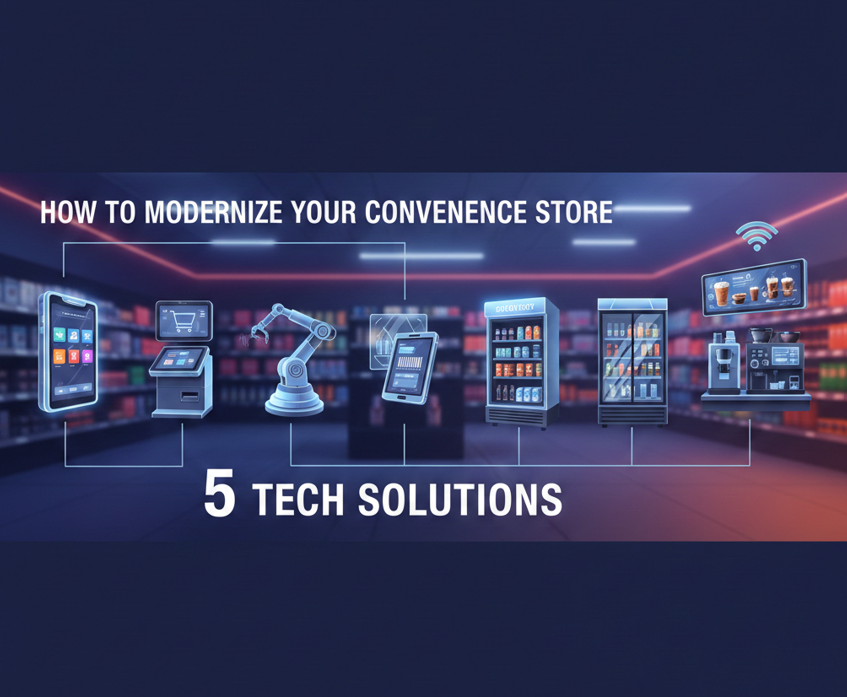
Want to modernize your convenience store but don’t know what technologies can help? Or do you want to know how advanced inventory management systems help convenience stores? No need to worry, we got you covered. Here’s a detailed blog that answers all your questions and gives top five tech solutions that you should include in your convenience store to modernize it.
Advanced Inventory Management System
An advanced inventory management system keeps your stock in check no more overflowing shelves or empty bins.
How It Works:
- The system continuously monitors stock levels with barcodes and IoT sensors which reduces human errors in stock counts and ensures the data related to product availability is always accurate.
- By analyzing sales trends, seasonal demand, and customer preferences the system helps in predicting future inventory needs and optimize stock levels.
- If you have stores with multiple outlets then this system has central dashboard features that allows you to monitor inventory across all locations. It also streamlines transfers between stores, saving time, and reducing excess stock.
Why Convenience Stores Need It:
- With it you quickly adapt to market demands by understanding market trends to make pricing decisions.
- Optimized stock levels and timely reordering reduce waste, shrinkage, and unsold items which directly contributes to higher profitability.
Key Benefits:
- Real-time inventory visibility to prevent discrepancies and manual counting errors
- Automated reorder reduces stockouts and overstocking
- Lower carrying and operational costs
- Enhanced security and loss prevention
- Streamlined operations through integration with POS systems
Drawbacks:
- Resistance to Change and Lack of Proper Training
- Phantom Inventory and Over-reliance on Automated Reordering
Use Cases:
- Real-time Inventory Synchronization with POS
- Automated Reordering and Stock Optimization
- Perishable Item and Expiration Tracking
Self-Checkout Systems and Mobile Payment Options
Self-checkout systems are automated kiosks that are present in-store that allow shoppers to scan, bag, and pay for the items without staff intervention which reduces wait times and staff reliance. Whereas, mobile payment options involve smartphones and wearables for contactless transactions. Both of them enhance speed and security.
How They Works:
- Customers scan items themselves using a scanner or touchscreen which instantly updates the store’s inventory and reduces checkout wait times.
- Customers pay using apps like Apple Pay, Google Wallet, or store-specific apps, linking their bank cards or digital accounts.
- Payments are processed immediately, and receipts can be sent digitally, providing convenience and clear records.
Why Convenience Stores Need It:
- With the help of multiple self-checkout stations, convenience stores allow more customers to pay simultaneously, reducing checkout lines and improving store efficiency during peak hours.
- A convenience store can easily track revenue and analyze sales trends efficiently with the help of digital records generated by mobile payments.
- Since Covid-19, many consumers prefer self-service and contactless payment options over traditional payment systems. It directly aligns with convenience and safety.
- Convenience stores rely less on cash which reduces handling and counting errors, and also the risk of theft is reduced.
Key Benefits:
- Streamlines small-item purchases and high-volume periods
- Boosts impulse sales with the help of faster transactions and grab-and-go placements
- Provides a smarter inventory management, promotions, and forecasting options
- Prepares stores for automation and AI-driven retail solutions
- Tracks peak hours, top-selling products, and payment trends
Drawbacks:
- Technical Issues and Frustration
- Reduced Customer Service and Human Connection
- High Implementation Costs
- High Shrinkage and Theft
Use Cases:
- Peak-Hour Rush Management
- Reduces Dependency on Multiple Cashiers
- 24/7 Operational Support
- Contactless and Mobile Payments
Electronic Point of Sale
Electronic point of sale or EPOS is a computerized system that combines software and hardware to process sales, track data in real-time, and process sales. It is a great modern and digital alternative to traditional and manual cash registers and helps in streamlining transactions of convenience stores which enables faster service and mobile payments.
How It Works:
- The EPOS system selects items on the touchscreen interface or scans barcodes to record every sale which helps in calculating totals, taxes, and discounts instantly for accurate billing.
- It connects with card readers and digital payment platforms to process debit/credit, cards, cash, and contactless payments seamlessly.
Why Convenience Stores Need It:
- The EPOS system has in-built ability to quickly scan and automate calculations. It reduces waiting times to improve customer satisfaction during peak hours.
- It updates stocks in real-time as something is purchased to prevent stock discrepancies and help C-store owners to manage their inventory effectively.
- Through a centralized interface for everyday work at C-store, these systems streamline inventory, sales, and reporting to reduce administrative workloads.
Key Benefits:
- Quick customer service during peak times
- Prevents convenience store from out-of-stock situations and overstocking
- Saves time on inventory audits and financial reconciliation
- Supports multi-location management for convenience store chains
- Provides actionable sales reports and trend analysis
Drawbacks:
- Total Dependence on Internet and Power
- System Downtime and Technical Glitches
- Complexity and Training Requirements
- High Upfront Expenditure for Hardware and Software
Use Cases:
- Streamlined Sales Transactions
- Centralized Inventory Management
- Customer Engagement and Loyalty
- Employee Management and Reporting
AI-Driven Demand Forecasting
AI-driven demand forecasting is something that has completely revolutionized the way convenience stores operate. It uses machine learning to analyze historical sales, local events, and trends to predict product demands. According to some reports online, it can reduce stockouts up to 65% and reduces waste due to expired items which allows stores to improve profitability.
How It Works:
- AI models analyze patterns and correlations in large datasets which enables the system to learn customer buying behavior over time and improves prediction accuracy automatically.
- The system also detects recurring patterns such as weekend spikes, seasonal product demand, and holiday surges for stores to prepare stock in advance.
Why Convenience Stores Need It:
- We know that customer preferences change quickly. With the help of you can respond faster compared to traditional manual planning methods.
- With accurate demand projections, store owners can place planned bulk orders and negotiate better pricing or delivery terms with suppliers improving overall margins.
Key Benefits:
- Predicts demand accurately to ensure popular products are always available
- Balances inventory with market demands
- Reduces unsold stock and maximizes revenue
- Eliminates manual planning by automating forecasting and replenishment saving staff time
- Helps plan store layout, stocking priorities, and pricing strategies
- Continuously improves predictions as more data is collected
Drawbacks:
- Complex Integration with Legacy Systems
- Over-Reliance on Historical Data
- Overreaction to Temporary Spikes in Demands
- Environmental and Security Concerns
Use Cases:
- Accurate Inventory Planning
- Waste Reduction of Perishable Items
Kitchen Robotics and KDS
Kitchen robotics and kitchen display system are two of the key technologies that drive food focused convenience stores. These systems have transformed simple grab-and-go shops into high-speed and automated food service hubs. Kitchen robotics use automated equipment including autonomous frying stations or robotic arms to cook food with minimal human interactions. Whereas, KDS is a digital interface that has replaced traditional and messy paper tickets in the food prep area.
How They Work:
- Recipes are digitally programmed into the system that allow robots to follow exact cooking temperatures, times, and measurements with precision.
- Orders from EPOS are directly sent to the robotic systems which reduces communication errors and speeds up food preparation.
- Orders are automatically organized based on time or urgency, ensuring efficient workflow during peak hours.
Why Convenience Stores Need Them:
- Robots operate continuously with high efficiency reducing the wait times during peak hours.
- It is ensured every item is prepared the same way to maintain brand standards and customer satisfaction.
- Digital ticketing eliminates paper order slips, supporting cost savings and sustainability.
Key Benefits:
- They improve customer satisfaction for ready-to-eat meals
- Allow staff to focus on tasks that add more value to the customer experience
- KDS ensures accurate order tracking
- Help optimize staffing, menu offerings, and supply orders
- Improve the overall perception of the store as modern and efficient
Drawbacks:
- High Maintenance and Downtime
- Impersonal Service and Consumer Perception
- Technical Failures and Complex Integration
- Lack of Flexibility and Customization
Use Cases:
- Automated Food Preparation
- Order Tracking & Management
- Integration with POS & Mobile Orders
Final Thoughts
Now, as we end the blog. We know how revolutionary these five technologies are. When you integrate them into your convenience store, they help you streamline operations, manage popular and unpopular products, enhance overall customer satisfaction, and improve store reputation. Use them and taste the success.