
Most logistics businesses face the same crossroads at some point. Do you buy software that works out of the box, or do you build something designed around how your operation actually runs? Off-the-shelf tools promise speed and lower upfront costs. Custom logistics software promises fit, flexibility, and long-term contract customization benefits.
Neither answer is wrong by default. But the wrong choice for your specific operation can cost far more than the software itself. This article breaks down both options honestly so you can make the decision that actually serves your business.
What is Off-the-Shelf Software?
Off-the-shelf logistics software is ready to deploy from day one. It is designed to have a wide appeal, to include a typical workflow throughout warehousing, freight, inventory, and order management, without any development investment requirement upfront. It does not take too long to get the job done on smaller operations or businesses with simple logistics requirements.
The tradeoff is control. These hubs are built to focus on the average user as opposed to your operation. When your processes are not compatible with the template, you adapt the software, but not the other way around. Such a tradeoff functions until it fails to, and in logistics, friction in operations is a compounder.
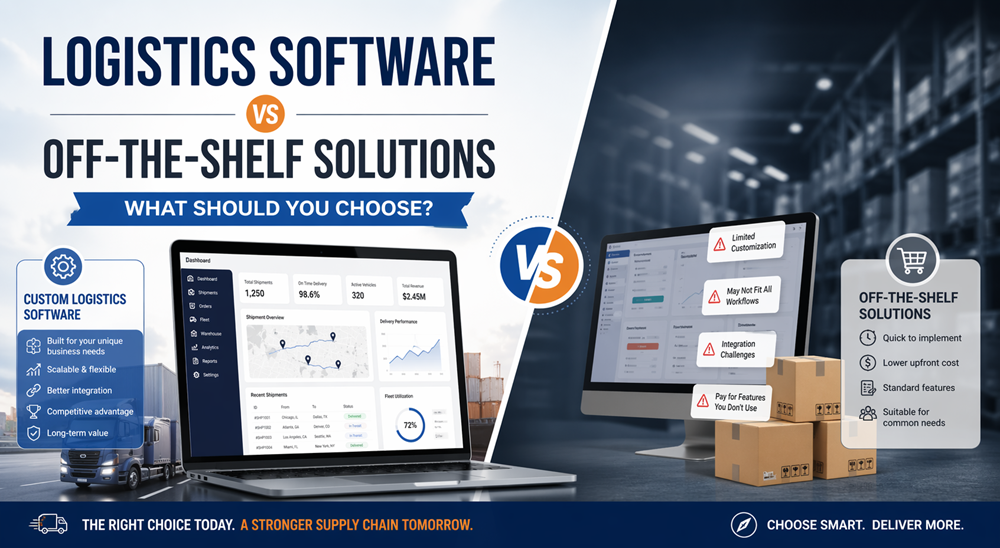
Pro & Cons of Off-the-Shelf Software
Pros:
- Quick Deployment: Completely deployed in a matter of days upon purchase with minimal configuration.
- Lower up-front costs: Subscription and license-based models ensure that start-up costs are within the financial reach of most budgets.
- Vendor Support: The package has frequent updates, patches, and access to a dedicated helpdesk.
- Stability: Proven to be stable through thousands of deployments, and reduces the risk of technical failures during the initial phases.
- Homemade Interface: Popular platforms have fewer staff onboarding and training periods.
Cons:
- Little Flexibility: Designed to fit the common user, not your logistics processes or business model.
- Logistics System Integration: Interconnection with the available tools tends to form data silos and ineffective handoffs.
- Scalability Problems: Volume or complexity may rapidly reach the limit of what such platforms are capable of.
- Vendor Lock-In: You are not able to update, set prices, or choose features.
Pro & Cons of Custom Software
Pros:
- Perfect Operational Fit: Built to fit into your workflows, without the compromise of generic platforms.
- Easy Integration: Seamlessly integrates with existing ERP, WMS, TMS, IoT solutions, and legacy systems without data silos.
- Scalable by Design: Adds capability and capacity as your logistics operation changes or as market needs shift.
- Competitive Advantage: Unique features and streamlined workflows that enable you to have an edge over the off-the-shelf competitors that can not cope.
- Full Control: You own the roadmap, updates, and feature priorities without a vendor roadmap.
Cons:
- Greater Start-up Cost: Design, development, and testing demand more initial financial investment than ready-made tool licensing.
- Prolonged Development Process: Construction requires time, the length of which depends on the scope and complexity of the project and when the project goes live.
- Maintenance Responsibility: Continuous updates, security patches, and enhancements are left to your team or development partner.
What is Custom Software?
The custom supply chain software is developed based on the way your business works rather than the way it should be. All workflows, integrations, and reporting requirements are architected to fit your unique logistics environment.
Such a fit is directly translatable into efficiency gains that generic platforms cannot possibly match. For logistics operations with high volumes, complex carrier networks, or industry-specific compliance needs, bespoke logistics software development will provide something that off-the-shelf tools can never provide: a system that keeps pace with your business rather than slow it down.
When to Choose Off-the-Shelf Logistics Solutions
Solutions that are off-the-shelf are not a bad option. They are the precise selection when it comes to a particular type of operation. When your logistics processes are not complex, your volumes are not too big, and the pace of deployment is more important than an exact fit, a pre-made platform may have you up and running in a short period of time without the bloat of a full development cycle.
These are solutions that are very effective in case your business is still in its infancy and requires a working system that requires no huge upfront investment. They are also appropriate in companies whose processes are closely aligned with industry standards and do not need a lot of customization to achieve results. When your team is not able to bear the cost of having the resources of an IT team to operate and maintain a custom system, an off-the-shelf system that is maintained by the vendor will relieve this whole burden.
Consider off-the-shelf logistics software when:
- You need a basic solution to kickstart supply chain operations quickly
- Your logistics processes are standard and do not require specialized workflows
- Significant operational scaling is not expected in the near term
- Your team prefers a low-maintenance platform with vendor-managed updates
- Your integration requirements are minimal and straightforward
- Internal IT capacity is limited, and ongoing development support is not feasible
- Budget constraints make a lower upfront investment the priority
The key is honest self-assessment. If your operation fits within what these platforms offer today and in the foreseeable future, there is no reason to overcomplicate the decision.
When to Choose Custom Software for Logistics and Supply Chain
Time is of the essence with bespoke software. It makes sense to invest when what you are doing is beyond the capacity of the usual platforms. When your supply chain is based on specialized workflows, operates across different regions with varying compliance needs, or relies upon a combination of both legacy and modern Web of Things solutions, off-the-shelf logistics software will never feel like a solution and will always be a workaround.
The solution is custom logistics IT solutions when the complexity of integration is high, when your competitive advantage will be based on how fast and precisely your operations are, or when you are developing a logistics model that is not based on traditional patterns. Ground-up scalable logistics platforms provide you with complete feature, update, and performance control without being bound to a vendor’s roadmap.
Logistics Software vs Off-the-Shelf Solutions
Here is how both options compare across the decisions that matter most:
| Factor | Off-the-Shelf | Custom Software |
| Upfront Cost | Lower | Higher initial investment |
| Implementation | Faster deployment | Longer build timeline |
| Customization | Limited | Built to your exact requirements |
| Feature Set | Broad but generic | Lean and purpose-built |
| Maintenance | Vendor-controlled | Full in-house control |
| Scalability | Constrained | Grows with your business |
| Long-term ROI | Moderate | Higher with proper execution |
| Integration | Often limited | Seamless with any stack |
| Risk | Vendor lock-in | Depends on development quality |
Conclusion
The decision between custom and off-the-shelf is reduced to one simple truth: Is your logistics process just another template in someone else’s, or is it worth the software that is created on its own complexity? Multi-system environments, high volumes, and specialized supply chain workflows are the answer for businesses that handle large volumes or have a multi-system environment.
INTECH delivers end-to-end logistics software development services built specifically for how your operation runs today and where it needs to go tomorrow. With 21+ years of enterprise IT experience and deep expertise across ports, supply chain, and distribution, we bring the technical depth and operational understanding that generic platforms simply cannot offer.
If you are ready to hire a logistics software development company that treats your business as the brief, not the afterthought, INTECH Creative Services is the partner built for that conversation.