
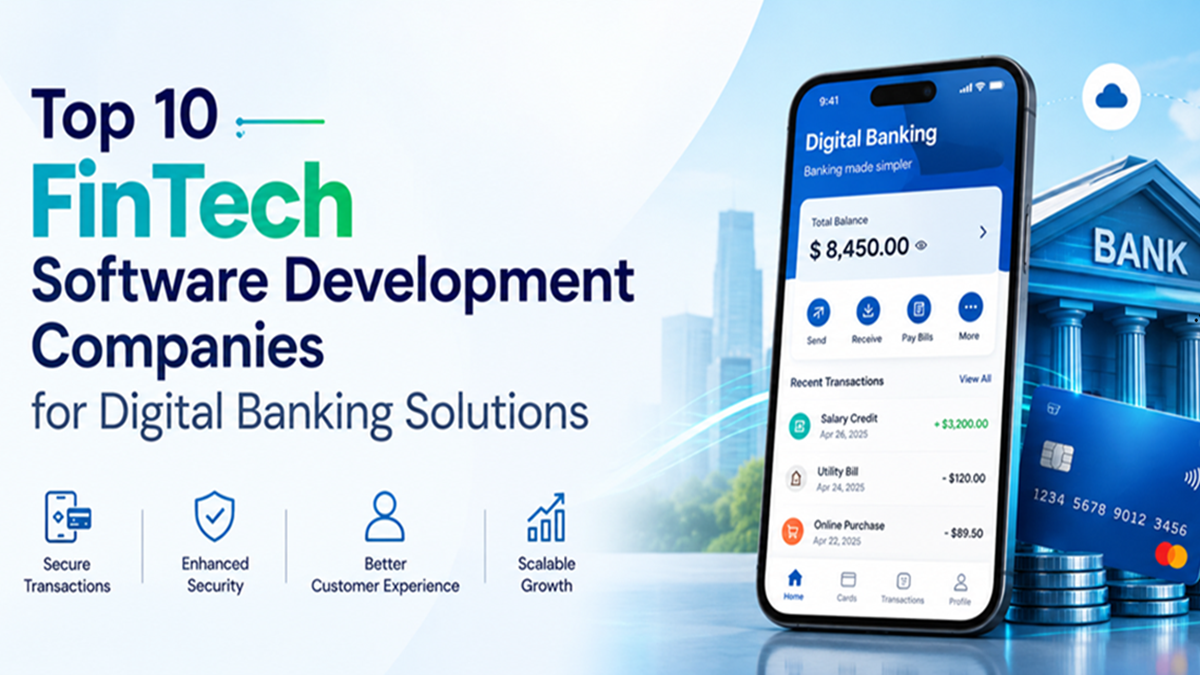
Contemporary banking has wholly transitioned from branch offices to cloud-native application suites, microservices, and real-time ledgers. Today, even established banks and fast-growing neobanks struggle to replace inflexible legacy cores with flexible, API-based ecosystems. Meeting rigorous security protocols such as PCI-DSS Level 1, ISO 27001, and SOC 2 Type II requires deep expertise. Working with reputable FinTech software development companies ensures the platform can process high transaction volumes without downtime.
Leading FinTech Software Companies Powering Digital Banking
- Seasia Infotech
Seasia Infotech is an innovative digital engineering company. It specializes in creating scalable software architectures for modern banking infrastructure.
Engineers at Seasia Infotech build resilient event-based architectures that allow financial institutions to de-monolith their mainframe codebases without stopping services. Their flagship solutions include real-time predictive analytics models integrated into transaction flows that improve processes such as KYC/AML screening and algorithmic risk profiling. Seasia Infotech is an all-round software development company that combines high-quality compliance standards with responsive, cross-platform user interfaces.
- EPAM Systems
EPAM Systems is a global engineering powerhouse that executes large-scale platform modernizations across tier-one banking institutions. The emphasis is on replacing legacy core banking systems with cloud-native microservices platforms that enable high-throughput, low-latency transaction processing.
EPAM has extensive experience navigating regulatory complexities across global jurisdictions. Using DevSecOps automation and modular software frameworks, EPAM helps legacy banks build robust, API-powered ecosystems. Legacy banks can incorporate modern credit scoring models, open banking architecture, and digital wallets along with their existing ledger systems.
3.Thoughtworks
Thoughtworks is renowned for introducing cutting-edge software development approaches like continuous delivery, micro-frontends, and Domain-Driven Design (DDD). Thoughtworks helps financial organizations break down monolithic architectures into evolutionary software components.
Their technical strategy centers around data mesh architectures and event streaming infrastructure. This enables digital banks to process millions of concurrent user events with strong transactional consistency. Organizations that partner with Thoughtworks are tapping into evolutionary platform engineering practices that accelerate deployment cycles and dramatically reduce technical debt over time.
- Intellectsoft
Intellectsoft has dedicated domain expertise in custom financial platform development, ledger engineering, and decentralized infrastructure. Intellectsoft is a FinTech development company that specializes in building custom banking platforms by integrating traditional core services with blockchain-based settlement protocols.
Its core engineering capabilities include modern mobile payment ecosystems, automated loan origination channels, and smart contract platforms for trade finance. Intellectsoft highlights end-to-end encryption, multi-factor authentication architectures, and secure API gateways to protect sensitive financial data on distributed ledger networks.
- DataArt
DataArt offers enterprise-grade financial software engineering services for asset managers, capital market platforms, and digital retail banking. Their engineering approach combines strong system architecture design with expertise in cross-border payment protocols and financial messaging standards like ISO 20022.
DataArt is a leading partner for cloud infrastructure modernization, complex database engine tuning, and building high-performance clearing systems. Their engineering teams ensure that the underlying ledgers can handle high transaction spikes reliably while maintaining low latency and full auditability.
- 10Pearls
10Pearls delivers intuitive digital financial products with high-velocity software engineering and advanced artificial intelligence capabilities. They specialize in developing customer-facing banking applications that use intelligent automation to customize the customer experience in real time.
AI-powered banking solutions are becoming more advanced, and 10Pearls helps financial companies keep pace by implementing conventional ML algorithms in their mobile finance stacks to automate customer support, identify payment anomalies, and simplify onboarding. The design-driven development approach also enables the company to implement security measures such as biometric verification.
- Andersen
Andersen is a leading European software development company with a strong practice in banking and financial technology solutions. They develop bespoke web and mobile platforms for commercial banks, investment firms, and emerging neobanking ventures.
Andersen invests heavily in developing compliant digital platforms. Their teams build secure payment processing gateways, self-service management consoles, and automated credit assessment engines. They ensure high availability in global deployment regions through containerized deployments and automated testing matrices.
- Ciklum
Ciklum offers custom product engineering teams to help global financial organizations accelerate digital innovation. They concentrate on build-operate-transfer models and bespoke co-development, helping banks to scale their internal technical capabilities efficiently.
The company’s Financial Engineering offerings include cloud-native payment aggregators, open banking API portals, and intelligent underwriting tools. Ciklum is known for agile software development practices, continuous integration pipelines, and automated security scanning for sustained delivery velocity without sacrificing system stability.
- Innowise
Innowise has vast technical expertise in custom financial software development, big data platforms, and intelligent banking applications. Their development teams help institutions build a modular core infrastructure that can support large numbers of daily transactions.
Innowise is focused on embedding machine learning engines for automated risk profiling, fraud mitigation, and portfolio management. Innowise develops adaptable software solutions by decoupling business logic from the underlying databases, enabling financial institutions to roll out new financial products quickly.
- KindGeek
KindGeek is a dedicated technology partner focused on developing white-label fintech platforms, digital wallet ecosystems, and advanced neobanking software. They help startups and mid-tier financial institutions launch compliant banking applications quickly.
KindGeek’s software architecture is built on modular API integrations, making it easy to connect with payment processors, identity verification services, and credit bureaus. Their core platforms provide end-to-end control of the transaction ledger, card issuance capabilities, and customer relationship interfaces.
Digital Banking Industry Shift – Major Architectural Trends
Shifted by real-time, event-driven demand, FinTech software development companies are replacing legacy batch systems. Three dominant technical movements that are actively redefining how modern banking stacks are engineered-
Integration of Autonomous Fraud Engine
Social engineering and transaction automation attacks are too advanced for traditional rule-based detection systems. Modern engineering teams implement real-time machine learning algorithms that analyze more than 100 behavior parameters per transaction in under 50 milliseconds. These algorithms analyze device telemetry, spending patterns, and location-data anomalies at once to protect against fraud.
Open Banking – Microservices & Interoperability
Global open banking guidelines require banks to make their core systems visible through publicly available APIs. Financial organizations are transitioning from traditional core database systems to containerized microservices orchestrated with Kubernetes. This architecture’s loose coupling ensures updates to specific components can be made without shutting down the entire core system.
Distributed Ledgers in Real Time
Consumer expectations are shifting to immediate payment settlement, and the traditional end-of-day batch processing is being phased out. Engineering teams are building on distributed ledger technologies and high-concurrency event stream platforms like Apache Kafka. This enables instant ledger updates, accurate balance checks, and instant reconciliations within multi-currency account structures.
Key Criteria When Selecting a FinTech Engineering Partner
Selecting the right development partner means looking beyond coding skills to engineering capabilities. Financial software requires precise operational execution and regulatory awareness.
- Regulatory & Compliance Awareness- Hands-on experience designing systems under PCI-DSS, GDPR, PSD2, and regional banking guidelines.
- Architectural Isolation- Requires the partner to use zero-trust network architectures, tokenized data storage, and strict API abstraction layers to protect sensitive personally identifiable information (PII).
- High concurrency testing- The company uses automated load testing frameworks that can simulate large spikes in real-time transactions without degrading the system.
- Data Governance & Auditability- The underlying platform must maintain immutable event logs to support internal risk assessments and regulatory audits.
Final Thoughts
Creating resilient digital banks requires an appropriate balance of agility and complete platform security. As financial service ecosystems become increasingly interconnected through application programming interfaces, embedded finance stacks, and real-time network processing, selecting suitable FinTech software development companies is a strategic priority today.
Working with engineering teams with strong technical capability and regulatory awareness, financial institutions can develop future-proof products with confidence that meet the needs of today’s digital banking.