

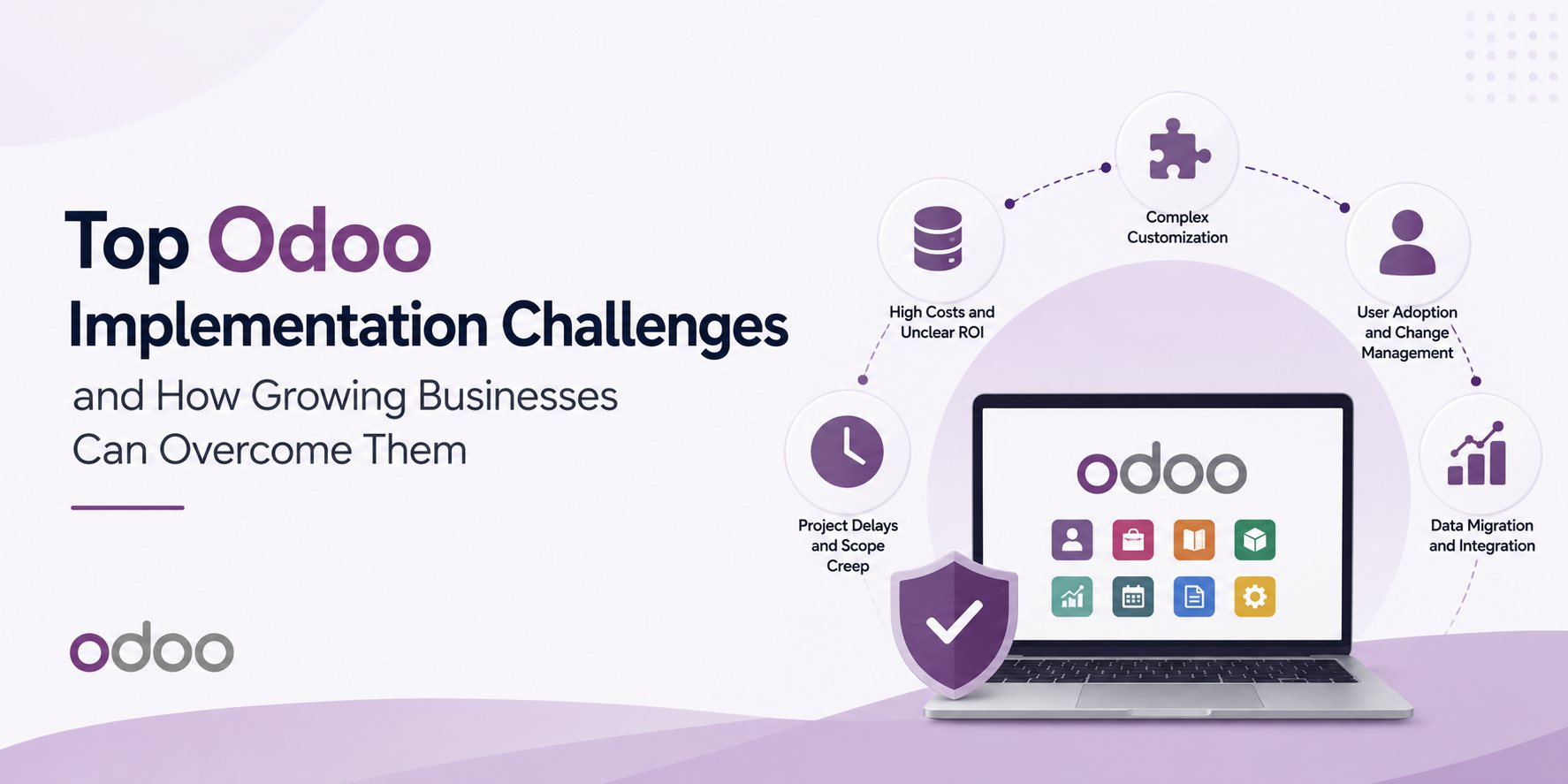
Every growing business reaches a moment where spreadsheets and disconnected tools simply cannot keep up. Odoo ERP promises a unified solution, but the path from decision to deployment is rarely as smooth as the sales pitch suggests.
The real challenge is not the software. Odoo is genuinely flexible and scalable. What trips most businesses up are the decisions made before go-live: how requirements are defined, whether data is ready, and how teams are prepared for change.
This guide walks through the biggest Odoo implementation challenges growing businesses face and, more importantly, the practical steps that help you avoid them before they become expensive lessons.
Why Odoo Implementation Is More Than a Software Deployment?
Most businesses treat ERP deployment as a technical project. In reality, it is an organizational shift that touches every department, process, and person in the company and that distinction changes everything about how you should approach it.
- Process Alignment: Odoo needs to reflect how your business actually operates, not an idealized version. Without mapping real workflows first, the system ends up configured around assumptions that do not hold in daily use.
- Data Readiness: Legacy data accumulated across spreadsheets and older systems rarely migrates cleanly. Unresolved duplicates, missing records, and format mismatches can delay your go-live and corrupt your opening balances.
- Organizational Change: Your team will need to abandon familiar routines and adopt new workflows. Without deliberate change management, even a well-configured system will face resistance that limits adoption for months.
- Stakeholder Alignment: Finance, operations, sales, and logistics often have conflicting expectations of what the ERP should do. Unresolved misalignment before deployment surfaces as expensive scope changes mid-project.
- Executive Commitment: ERP projects stall without visible leadership support. When decision-making is slow or priorities shift, timelines extend and teams disengage making an already complex project significantly harder to recover.
Businesses that treat implementation as a business transformation initiative from day one consistently achieves faster adoption, fewer surprises at go-live, and better long-term value from their Odoo investment.
The Biggest Odoo Implementation Challenges Growing Businesses Face
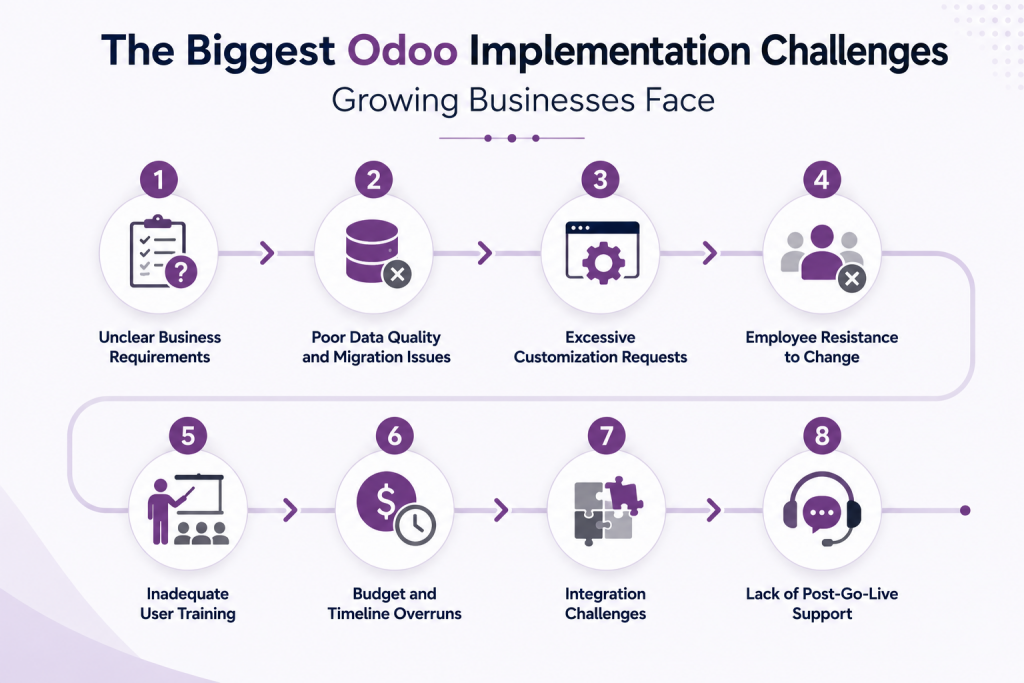
Growing businesses face a specific type of implementation pressure. They are too large to improvise and too lean to absorb a failed ERP rollout. Understanding the most common Odoo implementation challenges before the project starts is the single most effective risk management step available.
- Unclear Business Requirements
Projects that begin without thoroughly documented requirements almost always drift. Teams configure Odoo around assumptions, departments surface conflicting needs mid-project, and scope expands without a clear change process to manage it. The result is delays, budget pressure, and a system that partially fits nobody.
2.Poor Data Quality and Migration Issues
Data migration is consistently underestimated. Most growing businesses carry years of fragmented data duplicate customer records, inconsistent inventory costs, incomplete vendor details. Moving that data without first auditing and cleaning it populates a new system with old problems, which erodes trust in the ERP immediately after launch.
- Excessive Customization Requests
Odoo’s flexibility makes it easy to over-customize. The most common mistake is trying to replicate a legacy system exactly, rather than adopting Odoo’s native workflows. Every custom module added increases development cost, complicates upgrades, and creates dependency on developers for even routine changes down the line.
4.Employee Resistance to Change
People are naturally protective of processes they have refined over years. When an ERP arrives with little communication or involvement, teams find workarounds rather than embracing the system. Resistance is rarely about the software itself it is almost always a response to feeling excluded from a decision that directly impacts daily work.
- Inadequate User Training
A well-configured Odoo instance can still fail if the people using it do not understand it. Generic training sessions that walk through software features rather than real workflows leave users uncertain and prone to error. Low confidence at go-live translates directly into low adoption rates and an increase in support requests that overwhelm internal teams.
- Budget and Timeline Overruns
Scope creep is the most common driver of budget overruns in Odoo projects. Requirements that were not captured during discovery surface during configuration. Customization requests expand. Testing reveals gaps that require rework. Businesses that set timelines before understanding scope are almost always forced to renegotiate both before go-live.
7.Integration Challenges
Most growing businesses do not replace every tool when they adopt Odoo. E-commerce platforms, payment gateways, logistics systems, and accounting tools all need to exchange data reliably with the new ERP. Integration complexity is frequently underestimated, and gaps discovered late in the project are among the most disruptive and expensive to resolve.
8.Lack of Post-Go-Live Support
Go-live is not the finish line. In the weeks that follow, users surface questions, edge cases emerge, and process gaps appear that testing did not catch. Without a structured support arrangement, these issues accumulate. Teams revert to old habits, system confidence drops, and the long-term value of the Odoo implementation partner relationship goes unrealized.
What most of these challenges share is timing. The majority of Odoo implementation problems are set in motion well before configuration begins in how requirements are gathered, how data is treated, and how people are prepared for the transition ahead.
How Growing Businesses Can Successfully Overcome These Challenges?
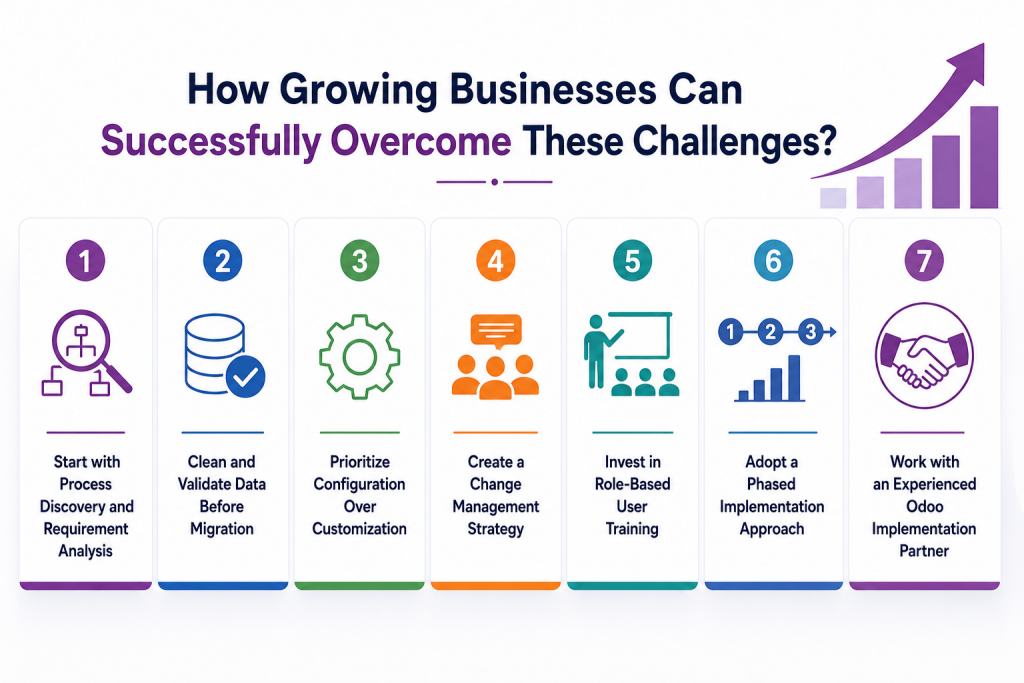
Avoiding Odoo implementation challenges is not about being cautious it is about being deliberate. The businesses that get implementation right are not necessarily larger or better resourced. They simply make better decisions earlier in the process, before problems become expensive to fix.
- Start with Process Discovery and Requirement Analysis
Before any configuration begins, map how your business operates today. Identify inefficiencies worth fixing, workflows that must be preserved, and objectives each department needs the system to meet. Documented requirements signed off by stakeholders prevent costly scope changes later.
2. Clean and Validate Data Before Migration
Conduct a data audit before the project kicks off. Remove duplicates, standardize formats, and assign clear ownership for each data set. Migrating to a staging environment first lets you validate against real business scenarios before anything touches production and your go-live opening balances.
3. Prioritize Configuration Over Customization
Exhaust Odoo’s native configuration options before requesting custom development. For every customization request, ask whether standard Odoo functionality can handle it with minor process adjustment. This discipline keeps upgrade paths clean, reduces development costs, and speeds up the overall Odoo implementation process significantly.
4. Create a Change Management Strategy
Communicate the project goals and timeline to all affected teams early and often. Explain what changes, what stays the same, and why the business is making this shift. Employees who understand the purpose behind the change are far more likely to support and adopt the new system willingly.
5. Invest in Role-Based User Training
Design training around what each role actually does in Odoo, not around software features in isolation. Warehouse staff, finance teams, and sales users all need different sessions. Hands-on workshops using your own business data are significantly more effective than generic platform walk-throughs for building real user confidence.
6. Adopt a Phased Implementation Approach
Rather than deploying every module simultaneously, start with the core modules your business depends on most. Go live, stabilize, and then expand. A phased rollout reduces project risk, gives users manageable learning curves, and allows the team to refine workflows based on actual usage before adding complexity.
7. Work with an Experienced Odoo Implementation Partner
An experienced Odoo implementation partner brings structured discovery practices, proven migration methodology, and post-go-live support that in-house teams rarely replicate alone. The right partner challenges over-customization, asks difficult questions during scoping, and stays engaged after launch to ensure the system continues delivering value.
None of these fixes require extraordinary resources. They require sequence and intention addressing the right things at the right stage of the project rather than reacting to problems after they have already affected timelines, budgets, and team confidence.
Odoo Implementation Success Checklist for Growing Businesses
Use this checklist before your Odoo ERP implementation begins. Each item represents a decision point where businesses commonly skip ahead — and where the cost of skipping tends to surface later at exactly the wrong moment.
- Defined Business Goals: Clear, measurable objectives aligned across all departments before scoping begins.
- Documented Workflows: Current-state and future-state process maps reviewed and approved by department leads.
- Clean Migration-Ready Data: Data audit completed, duplicates removed, and ownership assigned per dataset.
- Controlled Customization Plan: Every customization request evaluated against standard Odoo functionality first.
- User Training Strategy : Role-based training plan designed, scheduled, and resourced before go-live.
- Executive Sponsorship : A named executive sponsor with decision-making authority actively engaged throughout.
- Post-Launch Support Plan: Structured support arrangement confirmed with your Odoo partner before deployment.
Businesses that can check every item on this list before configuration begins are in a fundamentally stronger position not because the project becomes easy, but because the most common failure points are already addressed.
The Long-Term Benefits of a Well-Planned Odoo Implementation
A well-executed Odoo implementation does not just fix current operational problems — it builds the foundation for growth. Businesses report an average 20% reduction in operational costs within the first year, alongside measurable improvements in reporting accuracy, inventory visibility, and order fulfillment speed. These are not software features; they are outcomes of a structured deployment.
The productivity gains compound over time. When teams are properly trained and the system is configured to reflect actual workflows, manual effort drops. Finance closes faster, sales has better pipeline visibility, and operations runs with fewer bottlenecks. The ERP stops being a system people work around and starts being the system they actually work in which is the whole point.
Perhaps the most underappreciated long-term benefit is scalability. A well-implemented Odoo instance grows with the business. New modules can be added without re-architecting the core system. Third-party integrations connect cleanly to an already stable foundation. And when the business is ready to expand new teams, new geographies, new product lines the ERP is a platform that enables that growth rather than a bottleneck that constrains it.
Conclusion
Odoo implementation challenges are common, but they are not inevitable. The businesses that struggle most are typically those that treated ERP as a software project rather than a business transformation and discovered that difference only after go-live, when fixing it is far more costly.
With the right planning, a realistic scope, properly prepared data, and a capable Odoo implementation partner, most of the friction points covered in this guide simply do not happen. The investment in getting the process right upfront is almost always smaller than the cost of correcting it later.
FAQ
1. What are the most common Odoo implementation challenges?
The most common challenges are unclear business requirements, data migration issues, excessive customization, employee resistance to change, integration gaps with third-party tools, and inadequate user training. Most of these issues originate before deployment in how the project is scoped, how data is prepared, and how teams are involved in the process.
2. How long does an Odoo implementation take for a growing business?
For a mid-sized growing business, implementation typically takes three to six months depending on the number of modules, customization requirements, and the quality of existing data. Businesses that enter the project with clean data, a clear scope, and a phased rollout plan consistently come in closer to the lower end of that range.
3. Is Odoo customization always necessary?
No. The majority of growing businesses can meet their operational requirements using Odoo’s standard configuration and native features. Customization becomes necessary only when a genuine business requirement cannot be addressed any other way. Customizing to replicate a legacy system, rather than to meet a real business need, is one of the most common and costly mistakes in Odoo ERP implementation.
4. How can businesses improve Odoo user adoption after go-live?
User adoption improves when people are involved before go-live, not just trained at it. Appointing internal champions per department, designing role-specific training around real workflows, running a brief parallel period before retiring legacy systems, and providing accessible post-launch support all significantly increase the likelihood that teams actually use the system as intended.