


Prediction markets are changing the way people engage with real-world events from finance and politics to sports and global trends. What once felt like a niche concept is now becoming a powerful business opportunity, and entrepreneurs are quickly taking notice.
Instead of spending years building complex platforms from scratch, many are turning to Kalshi clone scripts to launch faster, reduce development risks, and tap into a rapidly growing user base. With the ability to turn market predictions into engaging trading experiences, these platforms are opening new doors for innovation, revenue, and long-term growth in the evolving prediction market space.
What is a Prediction market?
A prediction market is a platform where people trade on the outcome of future events. Instead of simply guessing what might happen, users buy or sell contracts based on real-world questions like
“Will Bitcoin cross $100K this year?” or “Who will win an election?”. The price of each contract reflects the collective opinion of users for example, if a “Yes” contract trades at $0.70, it means the market believes there is roughly a 70% chance of that event happening. This system works because it combines the knowledge, opinions, and data of thousands of participants into one real-time prediction.
A simple example would be a weather prediction market. Suppose there is a question: “Will it rain tomorrow?”. Users who believe it will rain buy “Yes” shares, while others buy “No”. If rain happens, the winning contracts pay out, and if not, they expire worthless. Platforms like Polymarket and Kalshi use this model for events ranging from politics and sports to crypto prices, economic indicators, and entertainment outcomes.
In terms of growth, prediction markets have evolved rapidly in recent years. Industry reports show that decentralized prediction marketplace development volumes have increased dramatically, with some platforms processing billions in annual trading volume. For example, Polymarket alone recorded billions in trading activity during major global events, while the overall prediction market industry is projected to reach nearly $95.5 billion by 2035, growing at a strong annual rate. Recently, the sector has expanded even faster, with prediction market activity increasing more than 130 times within two years, driven by mainstream adoption and institutional interest.
Today, prediction markets are no longer seen only as betting platforms — they are becoming powerful forecasting tools. Businesses use them to understand public sentiment, traders use them to hedge risks, and communities use them to predict outcomes more accurately than traditional polls or expert opinions. This combination of crowd intelligence, real-time data, and financial incentives is why prediction markets are rapidly becoming one of the most discussed innovations in Web3 and fintech.
Kalshi Clone Script- An Overview
A Kalshi Clone Script is a ready-made software solution that allows businesses and entrepreneurs to launch their own prediction market platform similar to Kalshi. Instead of building a platform from scratch, the clone script comes with pre-built features such as event-based trading, market creation, user management, wallet integration, and automated settlement systems, making the launch process faster and more cost-effective.
In simple terms, it enables users to trade on the outcomes of real-world events such as economic indicators, sports results, or financial trends where market prices reflect collective user predictions. For example, a platform owner can create a market like “Will Bitcoin cross $100,000 this year?”, and users can buy or sell positions based on their expectations.
For businesses, a Kalshi clone script acts as a strong foundation to build a scalable and customizable prediction platform. It helps entrepreneurs focus on growing their user base and market engagement while relying on proven technology that ensures transparency, security, and smooth trading experiences.
Advanced Features of Kalshi Clone Script
Real-Time Market Creation & Trading
An advanced Kalshi clone script allows users to create and participate in prediction markets instantly. Real-time data updates, dynamic pricing, and fast transaction processing ensure users can react quickly to changing events, making the platform more engaging and competitive. This feature helps maintain active trading volume and improves overall user retention.
Smart Contract-Based Automation
Smart contracts automate market execution and settlement, removing the need for manual intervention. Once market conditions are met, outcomes are processed automatically, ensuring fairness, transparency, and trust. This not only enhances user confidence but also reduces operational complexity for platform owners.
Secure Wallet Integration
The platform supports seamless integration with popular crypto wallets, enabling secure deposits, withdrawals, and trading activities. Advanced encryption and security protocols protect user funds and transaction data, creating a reliable environment for both new and experienced traders.
Advanced Admin Dashboard
A powerful admin panel gives platform owners full control over operations. Admins can manage markets, monitor trading activities, adjust platform fees, and access detailed analytics to understand user behavior. This helps businesses optimize performance and make informed strategic decisions.
Multi-Category Prediction Markets
The script supports multiple market categories such as finance, sports, politics, entertainment, and global events. This flexibility attracts a broader audience and keeps users continuously engaged by offering diverse prediction opportunities.
Scalable & Customizable Architecture
Built with future growth in mind, the Kalshi clone script allows easy customization and feature expansion. Businesses can modify workflows, add integrations, and scale infrastructure as the user base grows without affecting platform performance.
User-Friendly UI/UX Experience
An intuitive interface ensures users can easily create markets, place predictions, and track results without technical complexity. Clean design, responsive layouts, and smooth navigation enhance the overall user experience and encourage long-term engagement.
High-Level Security & Compliance Ready
The platform is developed with strong security layers, including data encryption, secure APIs, and protection against vulnerabilities. Compliance-ready architecture also helps businesses adapt to evolving regulatory requirements across different regions.
How a Prediction Marketplace Like Kalshi Works? – Step-by-Step Process
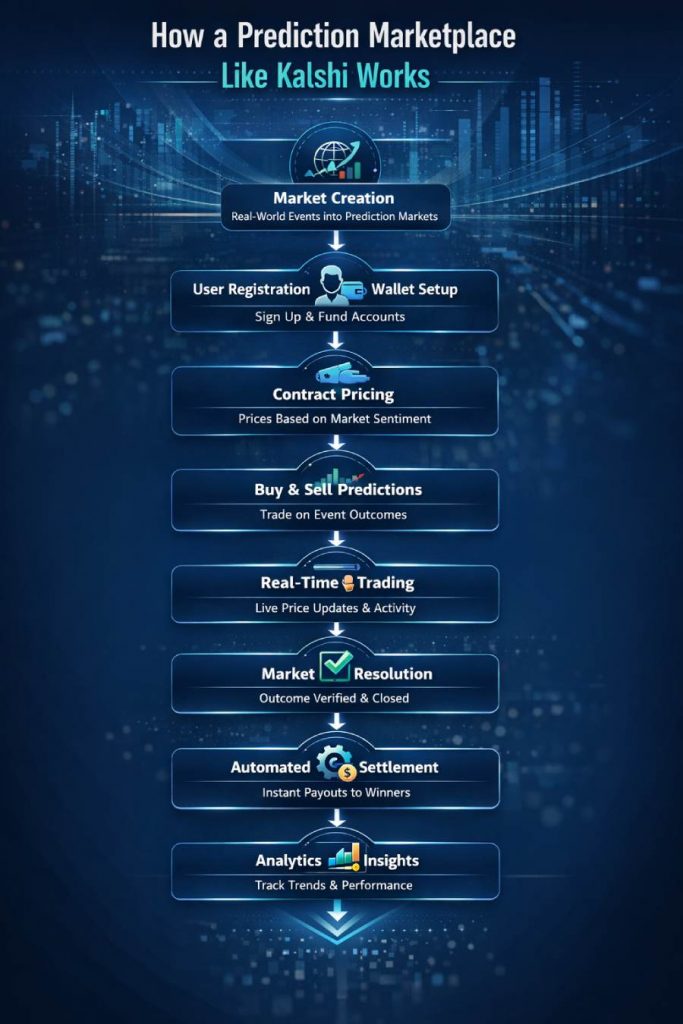
A prediction marketplace like Kalshi transforms real-world events into tradable markets where users can predict outcomes and trade based on their expectations. Unlike traditional betting platforms, prediction markets operate more like financial exchanges, where prices reflect collective market sentiment and probability. Here’s a detailed step-by-step explanation of how the process works:
1. Market Creation & Event Selection
The platform creates markets around real-world events such as economic indicators, elections, sports results, cryptocurrency prices, or global developments. Each market is built around a clear and measurable question for example, “Will Bitcoin cross $100K before a certain date?” The outcome conditions and settlement rules are defined in advance to ensure transparency.
2. User Registration & Account Setup
Users register on the platform and complete basic onboarding steps. Depending on the platform model, users connect their crypto wallets or fund their accounts through supported payment methods. This allows them to participate in trading securely while maintaining transparency in transactions.
3. Contract Pricing & Market Probability
Each prediction outcome is represented as a contract with a price that reflects its probability. For instance, if a “Yes” contract is trading at $0.70, it indicates a 70% market belief that the event will occur. Prices continuously change based on supply, demand, and new information entering the market.
4. Buying and Selling Positions
Users can buy contracts if they believe an event will occur or sell if they think it will not. Unlike fixed betting systems, users are free to exit positions before market closure by selling their shares, allowing them to manage risk and secure profits early.
5. Real-Time Trading & Market Activity
As news, data, and public sentiment change, users actively trade contracts, causing price movements in real time. This dynamic environment keeps the platform highly engaging and allows markets to reflect collective intelligence rather than individual opinions.
6. Market Monitoring & Liquidity Management
The platform ensures smooth trading by maintaining liquidity mechanisms and monitoring unusual activities. Admin tools and automated systems help maintain fair pricing, prevent manipulation, and ensure continuous trading flow.
7. Market Resolution & Outcome Verification
Once the event concludes, the platform verifies the result using trusted data sources or predefined criteria. This step is critical for maintaining user trust and ensuring accurate settlement.
8. Automated Settlement & Payout Distribution
After resolution, winning contracts are automatically settled. Users holding correct predictions receive payouts instantly, while losing contracts expire. Automation ensures speed, accuracy, and transparency.
9. Analytics, Insights & User Engagement
Prediction marketplaces also provide analytics dashboards that show trading trends, market sentiment, and historical performance. These insights help users make better predictions and help platform owners create more engaging markets in the future.
Final Thoughts
Prediction marketplaces like Kalshi are expected to evolve from niche trading platforms into mainstream decision-making tools. As users increasingly rely on data-driven insights, prediction markets will move beyond simple event forecasting and become powerful platforms where collective intelligence helps interpret real-world outcomes. Businesses, analysts, and institutions may begin using these platforms to understand public sentiment and probability trends in real time.
One of the biggest shifts will be the integration of AI and data analytics. AI-powered insights will help users analyze market trends, historical data, and probability movements, making predictions more informed rather than purely speculative. This will also improve market efficiency, helping platforms deliver more accurate price discovery and better user engagement.
Another major evolution is expected in regulation and institutional participation. As prediction markets gain legitimacy, regulated frameworks may allow broader participation from financial institutions and enterprises. This could bring higher liquidity, stronger compliance mechanisms, and increased trust among users worldwide.
Prediction marketplaces will also expand into multi-industry applications, including finance, insurance forecasting, supply chain risk analysis, and entertainment markets. Instead of being limited to politics or crypto, they will become versatile platforms where real-world uncertainty is traded and analyzed.