
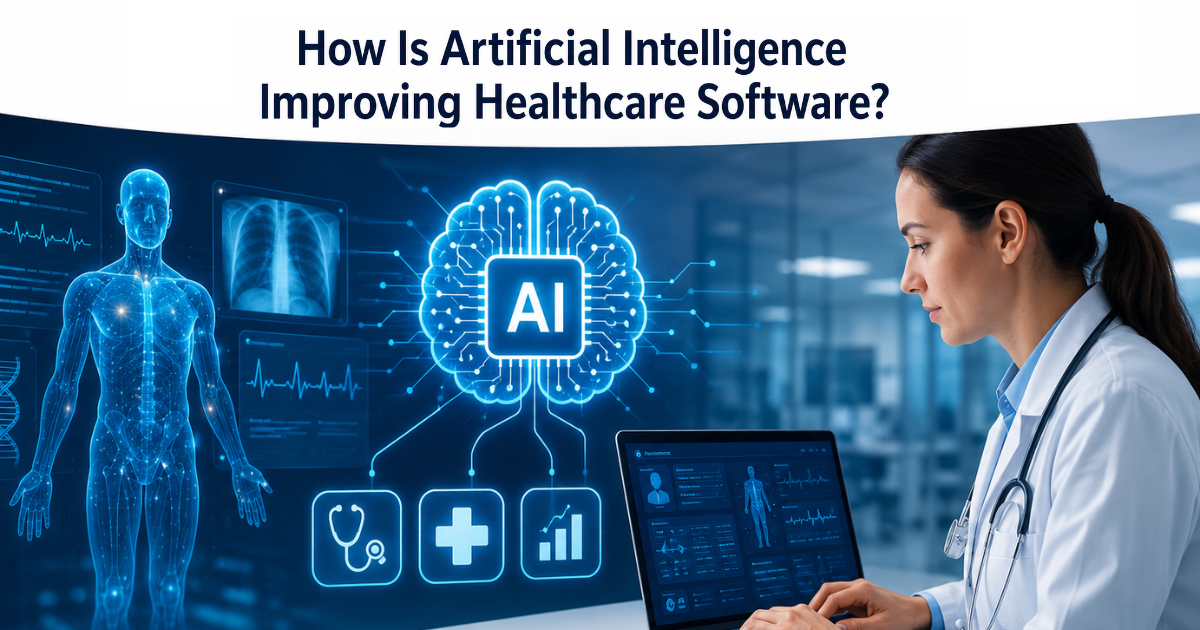
The healthcare industry is changing fast, and it comes with a bunch of advanced digital technologies, sort of everywhere. Among these upgrades, Artificial Intelligence (AI) is becoming one of the biggest, most transformative forces in modern healthcare software. It helps with diagnostics and patient care, yes, but also with automating routine admin stuff, and then there’s predictive analytics too. So basically, AI is reshaping how medical teams deliver services, day by day, in real workflows.
Hospitals, clinics, healthcare startups, and even pharmaceutical companies are putting more money into intelligent healthcare systems because they want better operational efficiency and improved patient results. Nowadays, healthcare software is not only traditional electronic health records or basic appointment scheduling anymore. AI-driven solutions are supporting smarter decision making, faster diagnoses, more tailored treatment plans, and real-time patient tracking, which sounds simple, but it really changes outcomes when it’s done right.
And as healthcare organizations keep pushing through their digital transformation path, the need for advanced healthcare software development solutions is growing quickly. At the same time, many companies choose to work with an AI mobile app development company to design intelligent healthcare applications. Those apps tend to include automation, analytics, and stronger patient engagement, not just dashboards for clinicians.
In this article, we’ll look at how artificial intelligence improves healthcare software, the main use cases, the benefits, the challenges, and what the future might look like for AI-powered healthcare systems.
The Growing Role of AI in Healthcare
Artificial Intelligence is basically a set of computer systems that can do tasks which usually need human intelligence, like learning, reasoning, spotting patterns, and choosing what to do next. In healthcare, these AI technologies are getting worked into software systems in a way that can help with, well, a bunch of things: analyze medical data, assist with diagnoses, automate routine workflows, foresee diseases, strengthen patient care, make hospital management smoother, and also support medical research.
Healthcare providers today produce a huge amount of information each day, think medical records, lab reports, imaging data, prescriptions, and patient histories. Then AI allows healthcare software to handle that information efficiently and come up with useful insights in real time. So, it helps clinicians make quicker and more accurate decisions, while also lowering the day-to-day operational load.
How AI Is Transforming Healthcare Software
1. AI-Powered Medical Diagnosis
One of the biggest contributions of AI in healthcare software is boosting diagnostic accuracy. AI algorithms can comb through and analyze things such as medical imaging, X-rays, CT scans, MRI reports, pathology slides, or even patient histories, and yeah, they can spot patterns faster than humans in a lot of cases.
Machine learning models, in particular, are able to identify abnormal signs, recognize diseases earlier, and help clinicians make a more precise call when diagnosing different conditions.
For instance, AI-enabled healthcare software may flag things like cancer, heart disease, neurological disorders, lung infections, or diabetic retinopathy. And when you catch it early, the success rates of treatments improve, plus it supports healthcare providers in delivering better patient outcomes overall.
2. Personalized Treatment Plans
Every patient responds a bit differently to treatments and medications. AI helps healthcare software sort of make personalized treatment plans based on patient-specific data and not just generic stuff.
- AI systems can scrutinize
- Medical history
- Genetic information
- Lifestyle habits
- Existing conditions
- Medication responses
And with that, doctors can suggest tailored therapies, plus updated medication schedules, which tend to boost effectiveness and also cut down unpleasant side effects.
So when healthcare organizations pick healthcare software development solutions, they can deliver more patient-centric care thanks to AI-driven personalization.
3. Predictive Analytics for Disease Prevention
AI-powered predictive analytics is getting healthcare providers to spot health risks earlier, before the condition gets severe.
In healthcare software, the system can sift through patient data and estimate things like
- Chronic disease risks
- Hospital readmissions
- Infection outbreaks
- Heart attack probabilities
- Diabetes progression
This kind of foresight supports preventive health strategies, which generally means fewer hospitalizations and lower treatment costs
For healthcare providers, that translates into better patient management and more proactive care delivery, kinda before issues escalate.
4. Virtual Health Assistants and Chatbots
AI-powered virtual assistants and chatbots are getting more popular in healthcare lately, like really more. In general, these smart systems are able to do things such as schedule appointments, field patient questions in real time, push medication reminders, and even help with symptom assessments. They can also give basic healthcare guidance , when appropriate, sort of at the starting point.
What ends up happening is that AI chatbots help boost patient engagement while also lightening the workload for hospital staff. Patients can get instant support, no long wait for manual assistance, which makes everything easier and more accessible.
So yeah, an experienced AI mobile app development company can build intelligent healthcare apps with built-in chatbot functionality, for smooth patient conversations and a more seamless flow.
5. Remote Patient Monitoring
AI-powered healthcare software sorta supports remote patient monitoring via wearable devices, plus IoT sensors. In practice, these setups can watch and log things like Heart rate, Blood pressure, Oxygen levels, Glucose levels, and Sleep patterns. Then AI does its analysis on the fly, and when it spots abnormal patterns or weird trends, it notifies healthcare providers, fast.
This kind of monitoring is especially helpful for older adults, chronic condition management, recovery after surgery, and telehealth services, too. Overall, it boosts patient safety while also cutting down hospital visits and lowering healthcare costs.
6. Drug Discovery and Research
Developing new drugs usually takes years of research and billions of dollars in investment. But AI is kinda speeding up discovery, because it can sift through complex biological data and point to treatment candidates more quickly than traditional approaches.
AI-powered healthcare software helps researchers do a bunch of things like, analyze clinical trial data, predict possible drug interactions, find molecular patterns, and even simulate how well a drug might work. Overall, this shortens the research timeline quite a lot and pushes pharmaceutical innovation forward faster.
7. Automating Administrative Tasks
Administrative inefficiencies are still a pretty big problem inside healthcare operations. With AI-powered healthcare software, repetitive work can be automated, such as medical billing, insurance claims processing, appointment scheduling, data entry, and documentation management. When these routine chores get handled by automation, it cuts down human errors, saves time, and leaves clinicians with more room to focus on patient care, not paperwork.
Hospitals that use advanced healthcare software development solutions can improve how smoothly things run, while also lowering administrative costs.
Benefits of AI in Healthcare Software
Improved Diagnostic Accuracy
AI tools help healthcare staff spot illnesses more precisely and also at earlier, stage.
Faster Decision-Making
With AI-driven analytics, professionals can reach medical insights and suggestions in a quick manner, faster than before.
Enhanced Patient Experience
Patients get care that feels more personalized, more reachable, and kind of speedy too.
Reduced Operational Costs
By automating routine tasks, organizations cut down manual effort, and they also make workflows smoother.
Better Resource Management
Hospitals and clinics can manage staffing, equipment usage, and patient handling in a more organized way.
Increased Accessibility
AI-based telehealth, along with mobile apps, extends services to remote communities.
AI in Mobile Healthcare Applications
Mobile health care applications are turning into this sort of key piece in the bigger digital health ecosystem, and yeah, it is not just a trend. Healthcare orgs are now working together with an AI mobile app development company to build smarter health apps that can do a bunch of things like virtual consultations, symptom checkers, medication tracking, AI-driven diagnostics, mental health support, and also fitness monitoring. Then there is remote patient care, too, where clinicians can stay connected without all the usual friction.
With AI integration, the whole app feels more intelligent and more responsive, like it can adapt better and deliver customized healthcare experiences, rather than one size fits all. And because these apps are cross-platform and cloud-enabled, healthcare providers are seeing improved patient engagement, plus operational scalability, at the same time.
AI in Healthcare Data Management and Interoperability
Another big space where AI is getting better in healthcare software is more about healthcare data management and interoperability. A lot of healthcare organizations still run into this thing where systems are fragmented, so patient info is kind of splintered across different departments, hospitals, labs, and separate software platforms. As a result it becomes tricky for medical professionals to pull up full patient records in a quick and efficient way, like in real time.
AI-powered healthcare software helps bring together and organize medical data from those various sources into something centralized. It can automatically process both structured and unstructured information, including clinical notes, lab reports, imaging records, prescriptions, and also patient histories, so the information doesn’t just sit there in pieces.
With intelligent interoperability solutions, healthcare providers can:
- Access patient records in real time
- Reduce duplicate medical tests
- Improve care coordination between departments
- Minimize data entry errors
- Enhance treatment accuracy
- Streamline clinical workflows
Natural Language Processing (NLP) also plays a big part by taking handwritten notes, voice recordings, and physician documentation and turning them into searchable digital records. it helps a lot with efficiency, and it really cuts down on those admin burdens that usually land on healthcare staff.
On top of that, AI-driven interoperability lets different healthcare systems and applications talk to each other pretty smoothly. This is especially handy in huge healthcare networks, where multiple platforms have to exchange patient information in a secure way and do it instantly.
So, when healthcare organizations look at healthcare software development solutions, they can lean on AI-powered interoperability to strengthen teamwork, enable faster treatments, and build a more connected healthcare ecosystem overall.
And as digital healthcare keeps expanding, intelligent data management systems will become more and more critical, not only for operational efficiency but also for patient safety and the quality of healthcare delivery.
Emerging AI Technologies in Healthcare Software
Machine Learning
Machine learning algorithms keep getting better through data analysis and pattern finding. It’s not just one thing; it sort of keeps improving as new data shows up.
- Some common uses look like:
- Disease prediction, like spotting possible illnesses early
- Risk assessment, assessing chances and outcomes
- Medical imaging analysis, interpreting scans, and related data
Natural Language Processing
NLP helps healthcare software deal with everyday human language, and it can turn it into something usable.
- You’ll see it in things like
- Voice recognition
- Medical transcription
- Clinical documentation
- Chatbots
Computer Vision
Computer vision lets healthcare systems make sense of medical images and videos.
- Typical applications include
- Tumor detection
- Radiology analysis
- Surgical assistance
Robotic Process Automation
RPA handles repetitive admin workflows inside healthcare organizations, kind of like nonstop back-office work.
- Applications are things such as
- Patient registration
- Billing management
- Claims processing
Challenges of AI in Healthcare Software
Despite its benefits, AI adoption in healthcare also brings a bunch of challenges, and honestly, it can get messy pretty fast.
Data privacy and security
Healthcare data is super sensitive, and it needs solid cybersecurity safeguards, not just “good enough”.
Regulatory compliance
Healthcare software has to meet rules like HIPAA and GDPR.
Integration with legacy systems
A lot of healthcare organizations still depend on old infrastructure, and that stuff may not make room for AI upgrades very easily.
High development costs
Creating AI-powered healthcare platforms can demand heavy spending, plus a real amount of technical knowledge.
Ethical concerns
AI systems should support transparency, fairness, and unbiased judgments in patient care, and that’s not a small requirement at all.
Future of AI in Healthcare Software
AI in healthcare looks kinda very promising. As these AI technologies keep evolving , the healthcare software itself will become more and more intelligent , even more predictive in practice. It’s like everything starts to anticipate what happens next
You can already see some future trends like
- AI-assisted robotic surgeries
- Voice-enabled healthcare platforms
- Hyper-personalized medicine approaches
- Predictive healthcare ecosystems
- Digital twins for patient simulation
- AI-powered mental health platforms
- Real-time disease outbreak monitoring
So yeah, healthcare organizations that invest in AI driven healthcare software development solutions are likely to get real competitive advantages, especially in efficiency, innovation, and patient satisfaction.
Conclusion
Artificial Intelligence is kinda revolutionizing healthcare software by letting systems do smarter diagnostics, predictive analytics, personalized treatments, workflow automation, and even more patient engagement. It’s like… healthcare organizations are now increasingly adopting intelligent technologies just to boost operational efficiency, and also deliver better patient outcomes. You can see it in a lot of ways, from AI-powered chatbots and virtual assistants to predictive healthcare analytics and remote monitoring setups. Basically, AI is reshaping what digital healthcare looks like.
If a business teams up with an experienced AI mobile app development company, it can craft innovative healthcare applications that offer scalable, secure, and patient-centric solutions. And as healthcare keeps evolving, AI-powered healthcare software is going to have a crucial role in building faster, smarter, and more easily accessible care systems for patients worldwide.