

Managing a loyalty program is relatively easy when you compare it with the next step of engaging the customers through offers that are customized for their liking.
Sending a discount to all members may receive some attention. However, this is not something that gives the customers any sort of acknowledgment of being recognized. On the other hand, designing discounts for each segment of the customers could be a laborious process for the retail team.
This guide explains what a loyalty campaign builder does, where traditional campaign management falls short, which features retailers should prioritize, how to create effective campaigns, and how to measure campaign performance.
What Is a Loyalty Campaign Builder?
The loyalty campaign builder allows stores to design, monitor, and analyze their loyalty campaigns.
Teams are able to define their offers, target audiences, rules, means of communication, and timing without having to build every promotion from scratch.
Today’s campaign creators can even link up with the checkout or point-of-sale systems, ensuring consistency between rewards, purchases, and campaigns.
Why Traditional Loyalty Campaign Management Is No Longer Enough
A loyalty program is able to gather important customer information; however, the information will only be useful if the retailers put it into practice.
Traditional campaign management often creates several problems.
Manual Campaign Creation Takes Too Much Time
Creating every campaign from scratch requires effort. It means that somebody has to choose the offer, pick the customers, develop the message, establish the dates, convey the offer, and track the results.
This may distract marketing teams from other tasks. Campaign creation tool offers retailers a repeatable process. They can create campaigns, define rules, schedule promotions and manage campaigns from one place.
Generic Promotions Deliver Limited Results
Everyone does not want the same thing. Someone who is always buying coffee will be interested in a coffee reward, while another person might be more interested in getting discounts on household products.
This would be ignoring the difference between the two customers. With customer segmentation, the retailer will be able to target campaigns based on purchasing behavior, interest, loyalty, location, and other relevant factors.
Limited Visibility into Campaign Performance
A campaign shouldn’t end when the promotion goes live. Retailers need to know what happened afterward. Did customers redeem the offer? Did sales increase? Did the campaign bring inactive customers back?
Without clear reporting, it becomes difficult to separate campaigns that perform well from those that need improvement.
Difficulty Scaling Loyalty Efforts
One campaign may be manageable manually. Ten campaigns across multiple customer segments and locations are much harder to manage.
When a loyalty program expands, the retailers must have some sort of mechanism that would enable them to manage additional campaigns without increasing their manual workload.
Key Reasons Every Retail Business Needs a Loyalty Campaign Builder
A campaign builder isn’t just about making promotions faster. It can change how retailers use their loyalty data.
Create Personalized Customer Experiences
The chances that the customers will take notice increase if the offer is relevant to them. The merchants can launch campaigns on the basis of buying history, product interest, customer behavior, tier of loyalty, etc.
The goal isn’t to personalize everything. It’s to make each campaign more useful to the people receiving it.
Launch Campaigns Faster
Timing is everything when it comes to retailing. The retailer may wish to have a weekend sale, a day sale, or even a whole-month sale depending on seasonality. The manual setup of each of these promotions is time-consuming.
A campaign builder lets retailers create campaigns and schedule their start and end dates in advance.
Increase Repeat Purchases
A loyalty campaign can be an additional motivation for customers to come back. A store can offer extra rewards after a set number of visits or a discount coupon after a customer spends a certain amount.
These campaigns connect the reward to a behavior the retailer wants to encourage.
Improve Customer Retention
Retention isn’t only about rewarding customers who already shop frequently. Retailers can also identify customers whose activity is slowing down and create campaigns designed to bring them back.
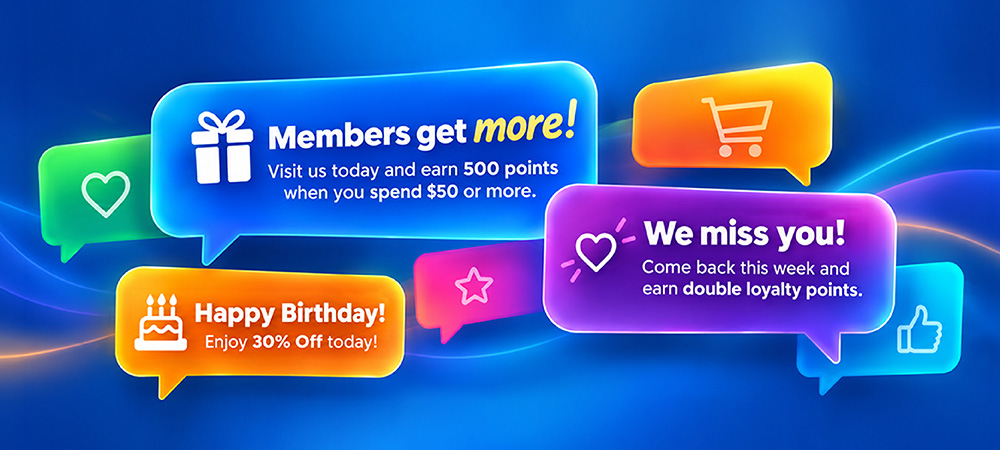
A simple “We Miss You” offer, for example, can target customers after a period of inactivity.
Automate Loyalty Campaigns
Some campaigns don’t need to be created and launched manually every time.
Birthdays, sign-ups, visits, and inactivity can be set to specific rules.
This automation makes it possible for the campaigns to start only if the trigger is there, which eliminates unnecessary work for the marketing team.
Increase Customer Lifetime Value
CLV is concerned with the value of a customer through their entire relationship with the company.
Loyalty programs can help with CLV by promoting frequent visits, bigger spending, and engagement.
The key thing here is that we should concentrate on behavioral factors and not just increase discounts.
Reduce Customer Churn
Customers rarely announce that they’re about to stop shopping. Their behavior usually changes first.
They might reduce the frequency of their visits, stop buying a certain product range or increase the gap between transactions. A loyalty program can react to such signals through an appropriate offer.
It helps merchants to reconnect with their clients before they leave entirely.
Essential Features to Look for in a Loyalty Campaign Builder
Not all tools provide the same degree of control. The retailer must find one that provides support to conduct simple promotions and loyalty programs as well.
Easy Campaign Creation
The campaign creation process should be straightforward. Retail teams shouldn’t need technical skills to create an offer, add campaign details, select a reward, and set up a schedule.
Customer Segmentation
Segmentation is one of the most useful features for loyalty marketing campaigns.
Look for the ability to target customers using information such as:
- Purchase history
- Shopping behavior
- Product interests
- Loyalty tier
- Location
- Customer activity
- Demographic information where appropriate
The more useful the segmentation options, the easier it becomes to create relevant campaigns.
Campaign Automation
Automation cuts down on tedious tasks. The retailer should be able to set off campaigns using triggers like signup, birthday, visit, shopping, or non-shopping activities.
This is particularly important for retailers who handle large loyalty audiences.
Personalization
The marketing campaign must be flexible in such a way that it adapts to various needs of the consumer.
Personalization may refer to the offer, target market, time period, or communication channel.
Multi-Channel Campaign Support
There are various ways through which customers can engage with the retailer. It is important that the loyalty campaign builder supports the channels that are relevant to the business such as email, SMS, mobile application, online shopping and in-store promotions.
Campaign synchronization will help ensure consistency in the customer experience.
Real-Time Data Integration
Campaigns are more effective when they are linked to up-to-date data about customers and their transactions.
POS integration will allow retailers to link purchase transactions to loyalty, reward, and campaign data.
Campaign Analytics and Reporting
The merchant cannot just click on the campaign’s start button; the report should demonstrate customer reaction and effectiveness of the campaign.
Check for engagement, redemptions, sales, customer activity, and revenue figures.
Flexible Campaign Rules
Various goals demand various rules. In the case of a retail store, one could opt to motivate customers to buy based on a number of considerations.
A flexible campaign builder should support different reward structures and conditions.
How a Loyalty Campaign Builder Works
The exact interface will vary between platforms, but the basic campaign process is fairly straightforward.
Step 1: Define the Campaign Goal
Consider what your intended result is to be. Do you intend to encourage repeat business? Move a particular product? Reactivate dormant customers? Boost order value?
Setting an explicit goal will simplify planning for the rest of the process.
Step 2: Select the Target Audience
Now comes the question of identifying the target for your campaign. These may be all loyalty customers, recent customers, valuable customers, inactive customers, or even customers showing interest in certain categories of products.
Do not select everybody just for convenience’s sake.
Step 3: Create the Offer
Determine what will be offered to the customers. Offer can consist of extra points or tokens, discounts, coupons or any other kind of incentive.
Rewards should have logic for both your customers as well as you.
Step 4: Set Campaign Rules
Define the conditions customers need to meet.
For example:
- Spend $50 and receive a reward.
- Buy a selected product and earn bonus points.
- Visit three times and unlock a coupon.
- Make a purchase during a specific period to earn an extra reward.
Clear rules make the campaign easier to understand and measure.
Step 5: Choose the Communication Channel
Choose how you want to inform your clients about the deal. It can be done via email, SMS, in-app messages, or even in store.
Your choice needs to align with the way your clients already communicate with your company.
Step 6: Launch or Automate
Some campaigns are required to operate during a certain period of time. Some campaigns are supposed to initiate only when the consumer fulfills a requirement.
With the help of scheduling and automation, retailers are able to conduct both sorts without having to start each campaign individually.
Step 7: Track and Optimize
Once the campaign goes live, monitor its performance. Check for redemptions, revenue, engagement, repurchases, and other metrics related to the initial objective.
If the campaign isn’t performing well, change the audience, the reward, the timing, or the communications rather than running the same campaign again.
How to Measure the Success of Loyalty Campaigns
A campaign isn’t successful just because customers use the offer. The right metrics help retailers understand whether the campaign produced meaningful business results.
| Metric | What It Measures | Why It Matters |
| Redemption Rate | The percentage of eligible customers who redeem an offer or reward. | Shows how appealing and relevant the campaign is to its target audience. |
| Repeat Purchase Rate | How often customers return and make another purchase after engaging with a campaign. | Helps show whether the campaign is encouraging ongoing purchasing behavior. |
| Average Order Value | The average amount customers spend per transaction. | Shows whether the campaign encourages customers to spend more per visit. |
| Customer Lifetime Value (CLV) | The estimated value a customer generates throughout their relationship with the business. | Helps retailers assess whether loyalty efforts are contributing to longer-term customer value. |
| Campaign Revenue | Revenue associated with customers or transactions influenced by the campaign. | Helps connect campaign activity with sales outcomes. |
| Engagement Rate | The level of customer interaction with the campaign. | Helps retailers understand whether customers are paying attention and responding. |
| Retention Rate | The percentage of customers who remain active over a defined period. | Shows whether loyalty efforts are helping keep customers engaged. |
| Return on Investment (ROI) | The return generated compared with the cost of running the campaign. | Helps determine whether the campaign is financially worthwhile. |
Conclusion
Loyalty programs are no longer just about rewarding points and discounts anymore.
Customers vary from each other in terms of needs, preferences, and behavior. For instance, what may be good for a loyal customer is certainly not going to work on a customer that doesn’t come around for months.
Loyalty campaign management allows companies to react to this diversity.
With an appropriate campaign builder, it is possible to launch more personalized offers, automate recurring campaigns, communicate with customers via multiple channels, and monitor performance.