

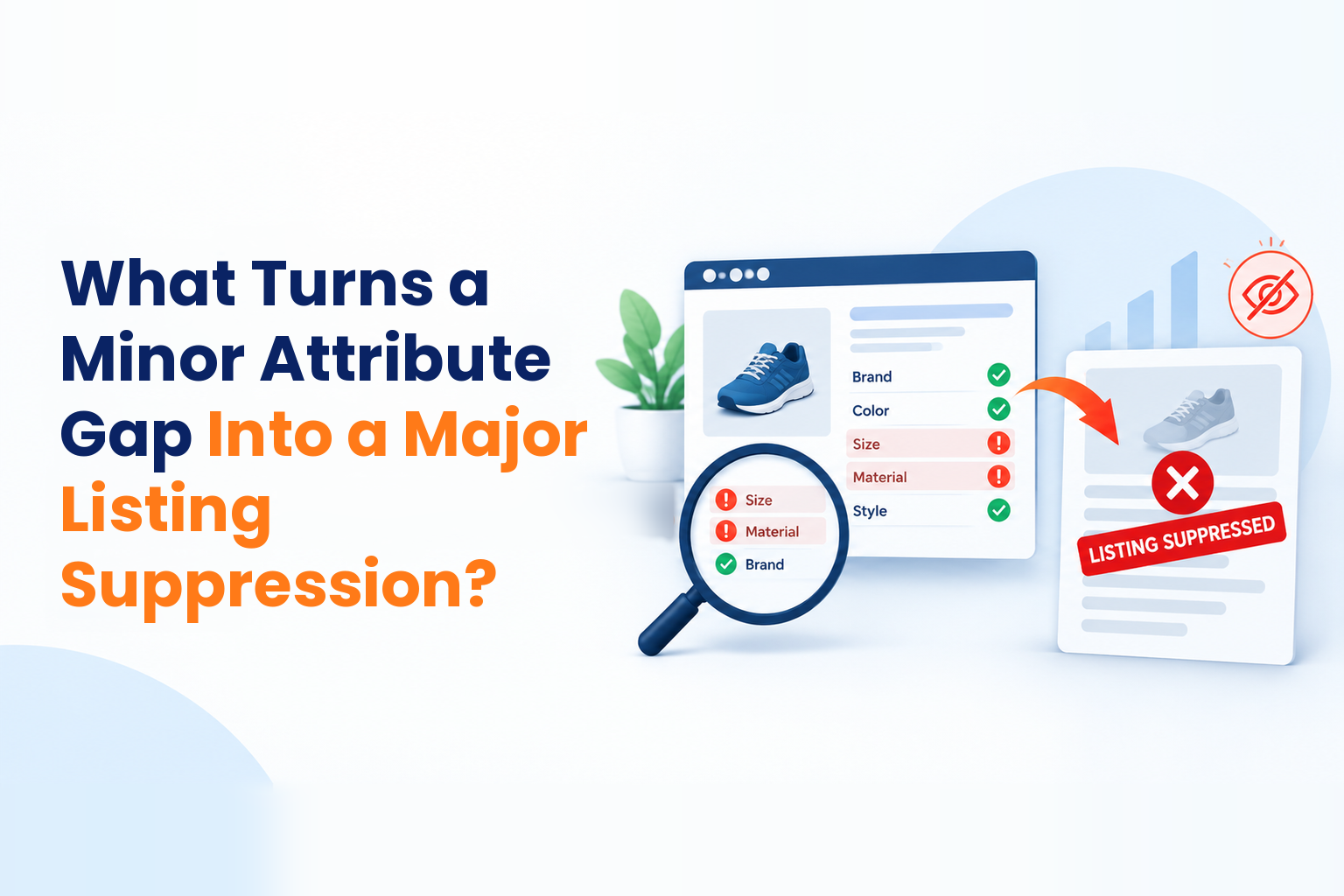
Listing suppressions are often the downstream result of product attribute gaps that go unnoticed until they affect a live listing. An SKU may go live with incomplete attribute data because some missing fields are recommended rather than mandatory. A field that is not required at onboarding can still affect listing visibility, filtering, or categorization later. Missing or inconsistent attribute data can limit how a product is represented and discovered across a channel.
The challenge is catching these issues while they are still minor data defects, not after they affect a live listing. A blank color value or a size value entered in an inconsistent format can remain in the product data without drawing attention. This article examines how those gaps persist, which attribute issues can lead to listing suppression, and how you can identify them before they become a larger listing problem.
Why Product Attribute Gaps Pass Validation at Onboarding
Initial product data validation focuses on required fields and checks whether their values meet the accepted formats and rules for the applicable category template. Four conditions that allow incomplete records to pass:
-
Recommended Fields Can Be Left Blank
Channels separate mandatory fields from recommended ones, and they accept records with blank recommended fields.
-
Some Fields Accept Non-Standard Values
Many fields accept non-standard values at onboarding, making entries such as “N/A,” “Other,” or “See description” pass initial validation even when a channel later requires a standard value.
-
Existing Templates Can Change Later
Validation is based on the category template in effect when the listing is submitted. A listing can pass at submission but face different requirements later if the template changes.
-
Channel Mappings Can Create Attribute Gaps
A master record in the PIM can satisfy one channel’s template but contain values that do not match another channel’s allowed values as the catalog expands.
Each of these gaps can remain unnoticed until a requirement changes or an edit triggers another validation pass. The listing can still remain active until then.
What Turns Product Attribute Gaps Into Suppression Triggers
Not all attribute gaps lead to product listing issues. Category templates, controlled values, and variant relationships are three common areas where small data gaps can trigger listing suppression.
Schema Drift in Category Templates
Amazon updates category templates regularly. For example, its April 2026 update revised attribute usage and enumeration values across different product types. The change covers listings with offers submitted through the Listings Items API or the JSON listings feed. Sellers on those paths must now supply values for newly added required attributes whenever they create or edit a listing.
When you edit an older SKU, Amazon validates the submission against the revised attribute set. That can surface errors in fields your team hasn’t changed in months. Enumeration changes create the same problem: a value that was valid when you created the listing can later disappear from the product type definition, causing the next edit to fail.
Value Normalization and Controlled Lists
eBay’s size standardization program illustrates how free-text attribute values can become a listing issue when a marketplace moves to controlled values. A size entered as free text may no longer meet the marketplace’s accepted values. In June 2026, eBay began normalizing high-confidence size values, converting entries such as “Small” to “S.” It also issued warnings on low-confidence entries such as “See description” or “N/A.”
Since August 2026, eBay can block or hold apparel and footwear listings, new or existing, that carry non-standard or missing size values. Normalization also leaves the seller’s source system holding “Small” while eBay displays “S,” so PIM and live-channel records diverge.
Variant Family Dependencies
Variation data carries compounding risk, because missing attributes on a single child record can affect an entire product family. Amazon illustrates this mechanism. When a child ASIN is missing its variation theme value, it cannot attach to the parent ASIN. The child can then appear as a standalone listing rather than as part of the product family.
Google applies similar scrutiny. Its product data specification lists missing or incorrect variant attributes, including item group ID, color, and size, among the causes of disapprovals and limited eligibility.
Where Listing Suppression Hits Revenue and Performance
A listing suppression affects more than the status of a single SKU. It can interrupt sales, reduce search visibility, stop associated advertising activity, and create additional remediation work across affected listings. The cost compounds across four areas:
-
Lost Sales & Organic Ranking
A suppressed listing loses search visibility, and its sales drop sharply for the duration. Its organic ranking, which depends on recent sales history, declines as a result.
-
Advertising Downtime
Listing suppression can interrupt advertising activity tied to affected products. Sponsored Products on Amazon require an eligible Featured Offer, so ads associated with an ineligible ASIN may stop serving until eligibility is restored.
-
Batch Remediation Load
When an attribute requirement changes for a product type, multiple SKUs under that product type can require updates rather than a single listing.
-
Recovery Lag
Reinstatement requires the channel to re-validate the corrected record, and ranking recovery begins only after sales resume.
The impact extends beyond the suppressed listing itself, affecting sales, advertising, catalog operations, and the effort required to restore normal listing performance.
Attribute Gaps to Prioritize for Review
Prioritize missing and inconsistent attributes based on their potential to affect listing eligibility and visibility. The following gap types align with the Amazon, eBay, and Google examples discussed above:
- Variation theme values: Match size, color, and size system values to each channel’s accepted value list for child SKUs.
- Placeholder entries: Remove values such as “N/A,” “Generic,” and “Various” where controlled lists do not accept them. For example, Google’s specification rejects “N/A” and “Generic” as brand values.
- Product identifiers: Supply the correct GTIN when one exists and keep identifier values accurate to avoid visibility limits or disapprovals.
- Units of measure: Separate numeric dimensions from their units instead of entering free-text values such as “approx. 12 in” where the template requires each field separately.
- Compliance fields: Complete battery, dangerous goods, and regulatory attributes where required to avoid triggering a compliance review.
How to Identify & Remove Attribute Gaps Before Listing Suppression
The goal is to find affected products when a marketplace changes its data requirements, not when the resulting listing issue reaches the storefront. That requires a change-driven review rather than a fixed calendar of catalog checks.
Track Effective Changes
Record the effective date, affected product types, attributes, and accepted values whenever a marketplace changes its requirements. For example, Amazon provides a PRODUCT_TYPE_DEFINITIONS_CHANGE notification when a product type changes.
Define the Scope of Affected Listings
Determine which product types, categories, and listings fall under the marketplace change. For example, if a new size requirement applies only to footwear, isolate footwear SKUs before checking whether their current values meet the updated rule.
Test Current Catalog Values Against the New Rules
Compare the affected records with the latest attribute definitions and accepted values before the next listing edit or feed submission. Amazon displays product type definitions through its Product Type Definitions API, while eBay provides category-specific item aspects through its Taxonomy API.
Check for Warnings Before Enforcement
Treat marketplace warnings as a remediation window rather than waiting for enforcement. For example, Google can warn merchants when channel updates require new or updated field values, and let them review affected products through ‘Needs attention’ and ‘View history’.
Prioritize the Affected Listings
Put products with active sales, high traffic, or material advertising exposure ahead of low-impact catalog records. This keeps remediation focused on listings where a data issue could have the largest commercial effect.
Verify Listing Status After Remediation
After correcting the source data, check the resulting listing status or issue state rather than treating the source edit as the end of the process. For instance, Google reports whether product issues remain in ‘Needs attention’, while Amazon provides listing-issue change notifications that include enforcement actions.
This workflow demands sustained, category-level attention. For many businesses, catalog teams absorb it alongside product launches and seasonal updates. Brands managing large multichannel catalogs often assign the monitoring cadence to product data management specialists. Internal teams can then concentrate on assortment and pricing decisions.
Keeping Minor Attribute Gaps From Becoming Listing Problems
Product attribute gaps are often minor. The major issue is leaving them in a live SKU until a marketplace change or listing edit brings them to light. Once that happens, the data issue can affect a product that already carries sales history, search visibility, and advertising activity. Strong catalog quality controls catch those gaps while they remain data issues, rather than waiting for them to become listing problems.
Author Bio- Hazel James is an eCommerce consultant at SAMM Data —a leading eCommerce growth agency offering product data management, eCommerce marketing, marketplace management, and branding & creative solutions. She works closely with 45+ brands to optimize their eCommerce operations and uncover new growth opportunities. Hazel excels at analyzing market trends, spotting emerging technologies, and implementing best practices, enabling businesses to maintain a competitive edge. With her expertise, she helps brands make data-driven decisions and streamline their operations, ensuring long-term growth and operational efficiency.