
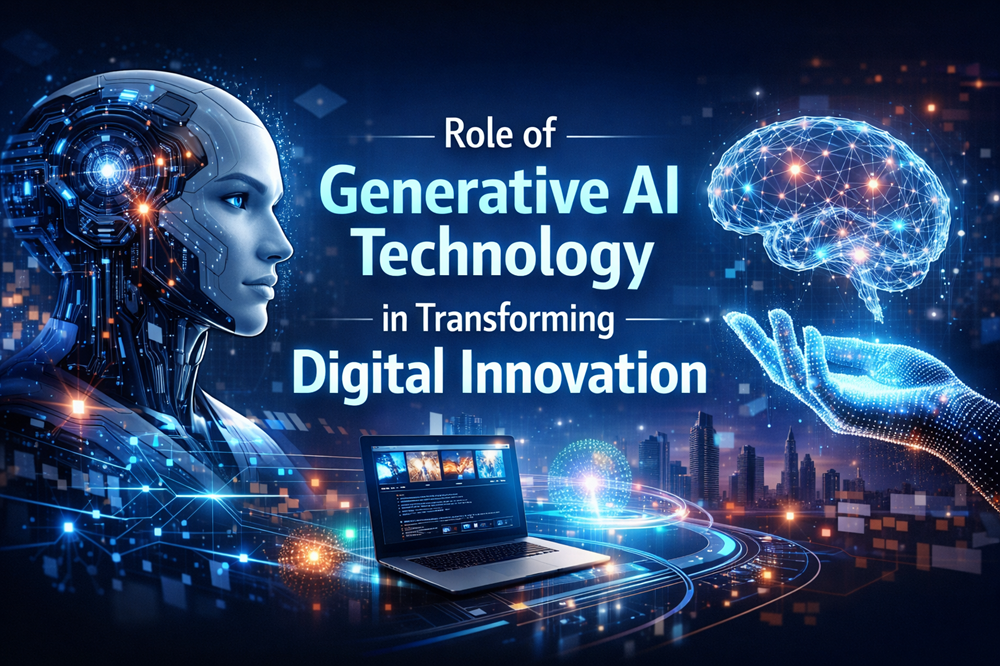
Digital transformation is not an aspiration; it is a process in motion. This process is happening at a rapid pace. Corporations in different fields are being compelled to become innovative, smarter, and adaptive in their experiences. Generative AI Solution is an example of a technology that has become a major facilitator of the digital innovations in this context. Let’s find out why generative AI is not a trend only, but the basis of digital innovations.
The Need for Faster, Smarter Innovation
Digital invention is developing at an unparalleled rate. Businesses are anticipated to innovate rapidly, make wise decisions, and scale their products simultaneously. Nevertheless, current procedures are not usually sufficient to manage such complexity and speed.
This is where the significance of generative AI technology belongs. Technology can enable organizations to escape the current processes and embrace new, dynamic, and data driven innovation. Whether it is the development of new applications or improving customer experiences, a comprehensive generative AI roadmap can enable companies to work on a new level that is entirely different.
What Makes Generative AI So Powerful?
In contrast to other automation technologies, which operate according to rules, generative AI learns from large volumes of data and generates new, meaningful information. This may involve:
- Writing that is human-like for content creation
- Writing code to speed up software development
- Creating images for design processes
- Giving insights on making intelligent decisions
This is a revolutionary change for how businesses function. While other technologies automate tasks, generative AI is involved in the actual creation of solutions.
Real-World Applications
The uses of generative AI are already diverse, and they include:
- Software Development: Coding & Code Optimization
- Marketing & Content: Blogs, Ads, and Campaigns
- Customer Support: Intelligent Chatbots and AI Agent Systems Powering
- Data Analysis: Extracting Insights from Huge Data Sets
- Product Design: Creating Prototypes and Concepts
By leveraging generative AI in development, organizations can run multiple innovation cycles at the same time, which has been impossible in the past.
Why Businesses Are Adopting Generative AI Rapidly
With the sophistication of digital ecosystems, businesses must have solutions that are flexible, scalable, and intelligent. The strategic gains that a properly implemented Generative AI Solution will enable businesses to benefit include:
Key Benefits
- Faster Product Development
Automate ideation, prototyping and testing in order to save time to market
- Enhanced Decision-Making
Utilize AI-based insights to make informed decisions
- Improved Customer Experience
Create “hyper-personalized” customer interactions with “intelligent” systems
- Operational Efficiency
Reduce human intervention in research, analysis, and other processes
- Scalable Innovation
Enable continuous improvement without increasing operational complexity
Generative AI vs Traditional Automation
To better understand its impact, here’s a quick comparison:
| Aspect | Traditional Automation | Generative AI Technology |
| Approach | Rule-based | Data-driven learning |
| Output | Predefined | Dynamic & creative |
| Flexibility | Limited | Highly adaptable |
| Use Cases | Repetitive tasks | Complex problem-solving |
| Innovation Capability | Low | High |
This shift from automation to intelligent generation is what makes generative AI a game-changer.
The Role of AI Agents in Digital Innovation
Among the new developments in this field, the advent of the so-called “artificial intelligence agent” can be regarded as one of the most thrilling ones. They are systems which are driven by generative artificial intelligence.
What Can AI Agents Do?
- Automate customer interactions
- Manage workflows and business processes
- Assist in coding & debugging
- Research and summarize results
- Execute multi-step tasks with minimal human input
AI agents do not merely exist as tools, but they are turning into digital co-workers, assisting teams in doing more with fewer resources.
Building a Generative AI Roadmap
The use of generative AI needs a clear approach. There should be a roadmap of generative AI development that will be specific to the businesses and their digital maturity.
Key Steps to Implementation
1. Identify High-Impact Use Cases
Focus on areas where AI can provide quick value
2. Assess Data Readiness
Ensure access to quality data for training and insights
3. Choose the Right Technology Stack
Select tools and platforms that support scalability
4. Start with Pilot Projects
Test and refine before full-scale implementation
5. Ensure Governance & Ethics
Address concerns around data privacy and AI bias
6. Scale Gradually
Expand AI capabilities across departments
An informed roadmap guarantees that generative AI development is both supportable and impactful.
Generative AI Across the Innovation Lifecycle
Generative AI doesn’t just augment one part of an innovation process but can actually amplify the entire process:
- Ideation – Generate new product ideas and concepts
- Design – Create prototypes and visual assets
- Development – Write and optimize code
- Testing – Find bugs and suggest fixes
- Deployment – Automate workflows and scaling
- Optimization – Continuously optimize based on feedback
This end-to-end support is why generative AI is becoming indispensable.
The Future of Digital Transformation
The role of generative AI will only become more robust as organizations keep on adopting the concept of digital transformation increasingly. It is not a mere technology but a strategic enabler that radically alters the manner by which businesses become innovative, competitive and grow.
Those companies that are investing in generative AI technology are spent on long-term success of their companies. They are not only building effective procedures but also smart, adaptive, and future-focused systems.
Concluding Thoughts
Generative AI is changing the digital innovation happening process. Whether it is the acceleration of the development processes or the ability to make prudent decisions, the effect is highly substantial and far-reaching.
The advantages of a powerful Generative AI Solution are agility, creativity, and scalability, which the business can enjoy by adopting the solution. Be it through innovative AI agent technologies, a strong generative AI roadmap, or generative AI development strategies, the possibilities are endless.
In an era where innovation is the only way to succeed, generative AI is no longer a choice; it’s a necessity. Those who get it and move with it are not only keeping pace with change; they’re setting the pace.