
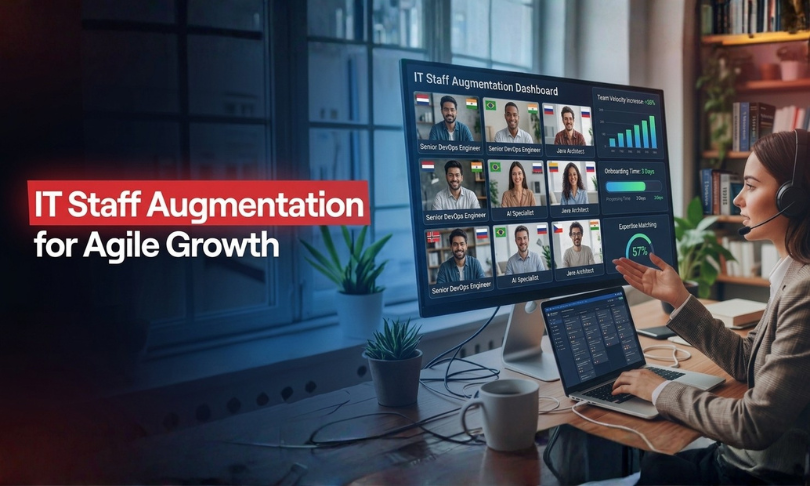
Markets are moving faster, product cycles are tightening, and technology teams are being asked to do more with less. Recent research directs a clear pattern: leaders want speed and adaptability, while skills are changing quickly, and tech talent remains difficult to secure. In that environment, IT staff augmentation services have moved from a backup hiring option to a practical growth model. It has become a way to add capability, protect delivery timelines, and scale without building permanent headcounts too early.
The real shift is not about filling seats. It is about adding the right capability at the right moment, without losing momentum.
In this blog, we break down how businesses are using IT staff augmentation services to scale capabilities, bridge skill gaps, and maintain delivery speed.
Why is This Model Gaining Ground?
The market is pushing organizations toward more fluid ways of working. Deloitte’s 2026 human capital research says 85% of leaders believe it is critical to build a workforce that can adapt at the speed required today. Meanwhile, the World Economic Forum’s 2025 Future of Jobs Report says 39% of core skills are expected to change by 2030. That combination explains why companies are leaning harder on flexible talent models that can move with the business instead of locking it into rigid hiring plans.
In practice, this means leaders are no longer asking only, “Can we hire someone?” They are asking, “How quickly can we bring in the exact skill we need, and how easily can that skill plug into ongoing work?”
What IT Staff Augmentation Really Delivers?
At its best, IT staff augmentation services give companies immediate access to specialized talent without the delay of a full-time hiring cycle. That matters when a project is already underway, the deadline is fixed, or the skill required is too narrow to justify a permanent role.
This model works well when a business needs to:
- Expand a product team for a release cycle
- Add niche technical expertise for a cloud or data project
- Support internal teams during a workload spike
- Test a new market or product line before committing to permanent hiring
- Maintain delivery speed while internal recruitment catches up
Used properly, staff augmentation is less about “outsourcing” and more about extending the core team with targeted capability.
Where Does the Model Fits Best?
Not every requirement needs a full-time hire. Some needs are temporary, highly technical, or tied to a specific business phase. That is where workforce scaling through augmentation becomes useful. The model is especially effective for:
- Product and platform work
When engineering teams are under pressure to ship, augmentation helps keep roadmaps intact without stretching the core team too thin.
- Cloud and infrastructure projects
Cloud migration, DevOps, and modernization work often need people with deep, specific experience. Bringing in that skill for a defined window is often more efficient than waiting months to recruit.
- QA and release support
Testing spikes are common before launches. Augmented talent can help stabilize delivery without long-term overhead.
- Data, analytics, and AI-enablement work
Many companies are still building internal capability in these areas. Temporary specialists can accelerate implementation while internal teams learn.
- Security and compliance assignments
These projects need precision and accountability. Bringing in experienced contributors can reduce risk and keep the work moving.
What has Changed in 2025 and 2026?
The newest trend is not simply “more remote work.” It is a more deliberate shift toward skills-first work design. Leaders are looking at capabilities, speed, and adaptability instead of relying only on traditional role structures. Deloitte’s 2026 research also points to rising pressure to redesign work around human-AI collaboration, not just headcount efficiency.
That matters for companies using IT staff augmentation services because the market now expects contributors to be productive quickly, collaborate across distributed teams, and adapt as scope changes. The old model of handing someone a long ramp-up and hoping for the best no longer fits most delivery environments.
There is also a stronger preference for flexible staffing solutions that can scale up or down without creating organizational drag. For many businesses, that is the difference between staying responsive and getting stuck in hiring lag.
Moreover, the rise of staff-as-a-service for businesses reflects this change:
- Talent is treated as a scalable layer not a fixed asset
- Teams are assembled around projects not departments
- External specialists work as integrated contributors – not outsiders
This approach blends internal stability with external flexibility – without compromising execution quality.
Why are Companies Choosing Augmentation Services Now?
There are a few reasons this model is becoming more common:
- Speed matters more than ever
When timelines are tight, waiting for a permanent hire can cost more than the role itself.
- Skills are changing fast
Technology stacks evolve, AI tools move into everyday workflows, and internal teams cannot always keep pace with every niche requirement.
- Delivery risk is easier to control
Adding a specialist for a clear scope can be safer than overloading a generalist team.
- It supports remote hiring patterns
Organizations that hire remote developers often need a structure that is lightweight, disciplined, and easy to manage across time zones.
- It helps preserve core culture
Instead of overbuilding the payroll, companies can keep their permanent team focused on the strategic center of the business.
Common Mistakes to Avoid
Many companies underuse augmentation because they treat it like a quick fix instead of an operating model. That leads to friction. Some common mistakes include:
- ringing in talent before the scope is clear
- Assigning augmented staff without an internal point of contact
- Expecting instant output without onboarding
- Giving vague goals instead of defined deliverables
- Failing to integrate external contributors into team rituals
A well-run model works best when the augmented talent feels like part of the delivery system -not a temporary add-on floating outside it.
The Business Case is Bigger than Hiring Relief
The value of augmentation is not limited to filling gaps. It helps companies test demand, protect speed, and stay selective about permanent hiring. It also creates room for leadership teams to make smarter decisions about where to build in-house and where to stay flexible.
That is why IT staff augmentation services are increasingly being used as a growth tool. They help organizations scale capability without overcommitting to structures that may not fit the next phase of the business.
Conclusion
Growth today depends less on how large your team is and more on how quickly your team can evolve. IT staff augmentation services offer a way to build that adaptability into your workforce model. They allow you to scale with intent, respond without delay, and execute without compromise. In a market where timing defines outcomes, that flexibility is not optional it is an operational advantage.
Need to scale fast? Get in touch with us to access on-demand expertise and keep your projects moving forward.