

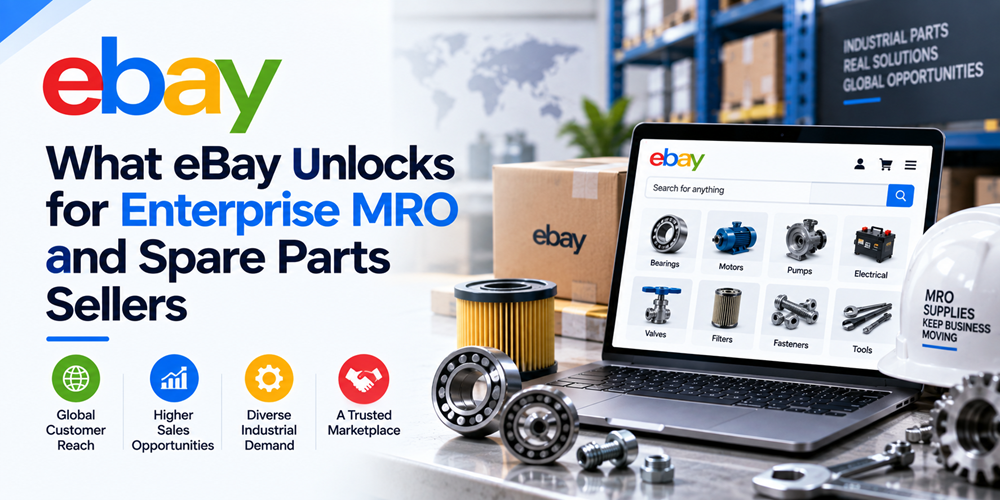
Every year, manufacturers retire equipment that other plants are still running. The parts those assets need have left the OEM catalog, and that mismatch has turned eBay into a working market for obsolete, used, and hard-to-find industrial components. Maintenance teams turn to the marketplace when conventional procurement channels no longer carry the part, and enterprise sellers sitting on that same inventory are positioned to capture the demand.
Selling spare parts on eBay places enterprise inventory directly in front of that demand. More than just a marketplace, eBay has become a channel that mirrors how industrial buyers already source critical parts. Auctions, fixed-price listings, and Best Offer give sellers three ways to price stock against what the market will actually pay. The sections ahead explore why the platform fits the realities of MRO procurement, what enterprise sellers need to manage operationally, and how organizations can turn overlooked spare parts inventory into a scalable sales opportunity.
The Hidden Revenue Opportunities in Enterprise Storerooms
Industrial storerooms often contain hidden revenue opportunities. Engineers hold insurance spares for critical equipment, procurement teams over-order to secure volume pricing, and equipment retirements leave components on the racks that no longer fit any running asset. While these parts may appear inactive, they can still hold significant market value when matched with buyers who need them.
Traditional disposal routes recover a small fraction of book value. Scrap dealers pay by weight, liquidation brokers demand deep discounts for bulk lots, and internal redeployment absorbs only a narrow slice of SKUs. As a result, enterprises lose the opportunity to connect valuable parts with buyers actively searching for them.
A direct-to-buyer marketplace channel like eBay changes that equation by listing individual components at part-level prices for the specific buyers who need them, allowing enterprises to unlock revenue from inventory that would otherwise remain idle.
Why eBay is the Powerful Marketplace to Sell Industrial Parts
eBay closed 2025 with nearly $80 billion in Gross Merchandise Volume (GMV), 135 million active buyers, and 2.5 billion live listings, according to its annual report. Scale is not the only reason to use eBay for industrial spare parts sales. The bigger advantage is that its marketplace structure matches how industrial buyers actually purchase:
Part-number search behavior
Maintenance technicians and procurement teams search by manufacturer part number, OEM cross-reference, or model compatibility. eBay’s search index surfaces exact matches, allowing a legacy PLC module to reach its buyer without any brand advertising.
Aggregated long-tail demand
eBay aggregates scattered global demand into steady sales. Through detailed Item Specifics, technical metadata, and off-site Google B2B search indexing, the marketplace connects sellers’ niche SKUs to industrial buyers during unexpected machine breakdowns.
Formats built for irregular inventory
Fixed-price listings suit standardized components, while Best Offer and auction formats let actual market demand set prices for rare or hard-to-value items.
A faster start than a standalone B2B eCommerce build
An eBay storefront goes live in weeks and skips the development, traffic acquisition, and payment infrastructure a proprietary site requires.
Built-in buyer protection
Every spare parts order is protected by the eBay Money Back Guarantee, protecting industrial buyers against wrong, damaged, or misdescribed parts. The Guaranteed Fit feature reduces purchase risk and can support higher seller conversions.
Industrial buyer demand is already active on eBay
Buyer behavior reinforces the case. Mordor Intelligence reports that online MRO purchasing continues to grow as procurement teams increasingly rely on real-time inventory visibility and parametric search capabilities.
This demand is already reflected in marketplace activity. Specialized sellers offer genuine TE Connectivity, Phoenix Contact, and Molex connectors, along with DIN-rail terminal blocks, as individual units. Their customers are often technicians and maintenance teams looking for a specific part needed to complete a repair. An enterprise seller with a broader inventory range can capture that same demand across a much larger selection of components.
How eBay Creates New Revenue Opportunities for Enterprise Spare Parts Sellers
The eBay Business & Industrial category gives industrial sellers access to buyers who are actively looking to purchase industrial products and replacement parts. For enterprises, the channel delivers value on four fronts:
Capital recovery from surplus inventory
Idle stock becomes a revenue-generating asset by reaching buyers willing to pay market prices, rather than being sold through low-value disposal channels.
Live price discovery
Sold-listing data reveals what slow-moving items actually command, helping enterprises price inventory more accurately, identify profitable opportunities, and improve future purchasing and write-down decisions.
Global reach without distribution agreements
Listings appear to buyers in international markets from day one, without distributor negotiations or minimum volume commitments.
Expanding aftermarket revenue without disrupting existing channels
Decommissioned, surplus, or refurbished stock sells under its own storefront and pricing rules, away from contracted distribution.
Enterprises that generate the most value from this channel keep listing year-round instead of running a single clearance push. Recurring listings of factory surplus, tested pulls, and refurbished assemblies build seller reputation, and reputation compounds into higher search placement and conversion over time.
Selling Spare Parts on eBay Demands Operational Discipline
Turning eBay into a reliable spare parts sales channel requires operational discipline. The marketplace relies on structured product data, seller performance standards, and compliance processes to maintain buyer trust at scale. Ongoing eBay marketplace management spans:
- Maintaining item specifics, condition grading, and manufacturer part numbers for every listing.
- Applying category and compliance rules, including restricted items and hazardous materials documentation.
- Monitoring account health metrics such as defect rate, late shipment rate, and case resolution times.
- Resolving listing suppressions, which remove products from search indexing until the underlying issue is corrected and reinstatement is complete.
- Managing returns, buyer messages, and competitive repricing across the catalog.
These tasks demand daily attention, not quarterly review. A single unresolved compliance flag can suppress listings and stall sales velocity while the issue waits in a queue. For that reason, many enterprise sellers delegate day-to-day eBay account management to specialist teams and keep internal staff focused on sourcing, production, and fulfillment. Others build the capability in-house with dedicated marketplace operations roles. In both models, channel performance tracks the operational discipline behind it.
What You Cannot List on eBay From an Industrial Storeroom
Before starting any operational work, you must finalize the catalog. Some industrial inventory can be listed easily, while other items require special handling or cannot be sold through the marketplace.
| Storeroom stock | eBay status |
| Refrigerant cylinders and other ozone-depleting or high-GWP gases | Prohibited, covering CFCs, HCFCs, HFCs, and non-EPA-approved substitute refrigerants |
| Plant chemicals such as acids, caustics, methylene chloride strippers, and trichloroethylene | Prohibited as corrosive or carcinogenic materials |
| Loose 18650 cells pulled from UPS or tool packs | Not allowed on their own; they must be pre-installed in a product |
| Parts under an open manufacturer or agency recall | Not allowed, along with items missing a required UL marking |
| Tool battery packs, aerosols, and flammable liquids | Listable, but hazmat rules govern the carrier and the labeling |
None of these are edge cases in an industrial setting. They are standard storeroom holdings that fall under rules written for safety and transport rather than commerce, which is why they pass an inventory review without reconsideration.
Identifying them early keeps the exclusions on a spreadsheet, where they cost nothing, instead of in a listing queue, where each one carries a policy consequence.
A Five-Step Framework for Operationalizing MRO Spare Parts Sales on eBay
A structured approach prevents the two most common failures: listing junk that damages seller metrics and listing valuable stock with too thin data to rank. Work through the sequence below:
1. Audit and identify the right inventory to list
Pull every SKU with zero movement over 24 months, exclude insurance-critical spares, and rank the remainder by book value and resale potential.
2. Prepare the product data
Compile manufacturer part numbers, cross-references, condition grades, and clear photographs for each product. Complete product data improves search visibility and builds buyer confidence.
3. Set pricing and format rules
Benchmark sold listings for comparable items, assign fixed prices to standardized SKUs, and route rare items through Best Offer or auction for price discovery.
4. Assign compliance and account-health ownership
Allocate ownership for policy adherence, defect-rate monitoring, and case resolution before the first listing goes live.
5. Review channel KPIs monthly
Track sell-through rate, recovery against book value, days to sale, and account health, then feed the findings back into storeroom purchasing decisions.
The Bottom Line for Enterprise Sellers
Every Enterprise MRO spare part that left the OEM catalog didn’t stop being useful. They stopped being available through conventional channels, and that is exactly the gap eBay fills. For enterprises holding that inventory, the marketplace turns a shelf of superseded components into a revenue line priced by real demand.
Catalog preparation and account-health ownership are what the channel asks in return. Enterprises that meet those requirements and list year-round build something more durable than transactions. Each sale reports what a component actually commands, seller standing improves with volume, and every listing reaches buyers already searching for that part.
Author & Bio:
Sophie Hayes is an eCommerce consultant and a keen blogger, currently working at Team4eCom (Full-Service eCommerce Agency). With over 11 years of experience in the industry, she specializes in topics revolving around the eCommerce domain, such as online marketing, eCommerce PPC, store optimization, listing optimization, and product listing. Moreover, she has a great knowledge of the leading eCommerce platforms and marketplaces like Amazon, eBay, Walmart, Target, and others. She incorporates this understanding in her write-ups to help online retailers and businesses follow the best practices, take their business to new heights, and gain a grounded footing in the market.